.avif)


Key Takeaways
Latest Update on July 14, 2026
- Who is in Scope: The CSRD directive primarily applies to entities that exceed specific size requirements, typically those with more than 1,000 employees and a net turnover of €450 million.
- Mandatory Filter: Double Materiality builds the essential filter for all disclosures, with a short explanation required if Climate Change (E1) is deemed non-material.
- Value Chain Relief: A three-year transitional period allows companies to omit granular supply chain data if it is not readily available.
- Proof is Paramount: Successful compliance in 2026 requires moving from simple data collection to centralized Proof Management to bridge the gap between knowledge and audit-ready evidence.
What is CSRD and Why Does it Matter?
From NFRD to CSRD: The Basics
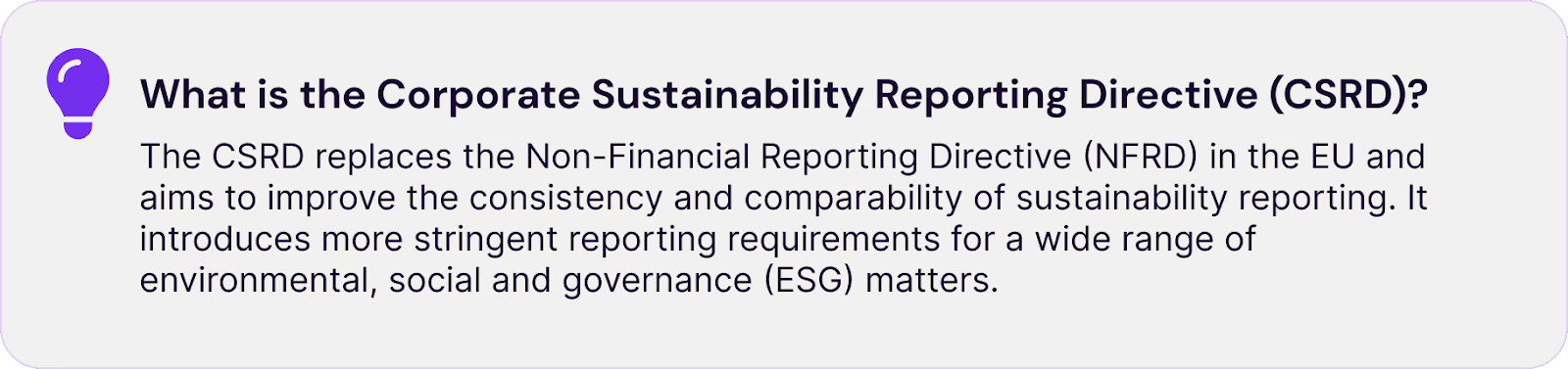
The CSRD (Corporate Sustainability Reporting Directive) is an EU directive that regulates sustainability reporting by companies. It replaces the previous directive, the Non-Financial Reporting Directive (NFRD), and introduces stricter and standardized requirements for ESG issues (environmental, social and governance) in order to promote transparency and comparability.
Why Is the CSRD Important?
As highlighted by the European Parliament, the significance of the CSRD is transformative: for the first time, sustainability reporting is placed on an equal footing with financial reporting.
The introduction of the CSRD reflects the European Commission's commitment to corporate accountability. By providing a robust, standardized framework, the directive encourages responsible business practices to achieve critical sustainability goals, such as the EU's target of net-zero emissions by 2050.
While the first wave of companies began compliance in 2024, the 2026 Sustainability Omnibus I Directive has further refined the landscape. This simplification package ensures that reporting remains focused on the most impactful entities while replacing the outdated Non-Financial Reporting Directive (NFRD).
The primary objective of the CSRD is to standardize global ESG (Environmental, Social, and Governance) reporting. This is achieved through the European Sustainability Reporting Standards (ESRS), a mandatory double materiality assessment, and a third-party audit process to ensure the accuracy and reliability of all disclosed information.
Who Is in Scope and When? The Timeline of the Omnibus Correction
The scope of the CSRD has been refined by the 2026 Omnibus I Directive to reduce administrative burden while ensuring high-impact transparency. Today, the directive applies to three distinct "waves" of companies based on their size and turnover. The following table reflects the 2026 legal landscape. If your company exceeds both the employee and turnover thresholds for two consecutive years, you are within the mandatory scope.
CSRD VSME: Voluntary Standards for SMEs
The Omnibus package has fundamentally redefined the scope of the CSRD by raising the reporting thresholds. While this means fewer companies are now legally required to submit full sustainability reports, many still face increasing data requests from larger customers who must report on their own value chains.
To manage this, the Voluntary Sustainability Reporting Standard (VSME) offers a compact and structured framework for non-mandatory reporting. It provides a standardized way to share ESG data with business partners who remain within the scope of the CSRD. Companies can choose between the Basic Module, designed as a simple entry point, or the Comprehensive Module, which provides deeper insights into strategy and management.
Adopting these standards not only increases transparency for internal and external stakeholders but also prepares companies for a potential future transition to more rigorous requirements. The VSME specifically supports the thousands of "Small Mid-Caps" that, while not legally obliged to report, must still provide credible sustainability data to remain competitive in their customers' supply chains.
CSRD Compared to other Laws and Directives: What is the Difference?
The CSRD does not exist in a vacuum. It is the reporting engine that sits at the center of several other EU and national regulations. Here is how they interact in 2026:
CSRD vs. EU Taxonomy
Both are pillars of the European Green Deal, but they serve different functions. The EU Taxonomy is a green dictionary: It provides a classification system that defines which economic activities are substantially aligned with the European sustainability targets. The CSRD is the megaphone: it requires companies to disclose exactly what percentage of their turnover, CapEx, and OpEx aligns with that dictionary. In 2026, Taxonomy reporting is fully integrated into the digital ESRS templates.
CSRD vs. CSDDD
The Corporate Sustainability Due Diligence Directive (CSDDD) is about action, while the CSRD is about disclosure. Under CSDDD, companies must actively identify, prevent, and mitigate human rights and environmental risks in their value chains. The Omnibus I Package (2026) finalized the "Once-Only" principle between these two: companies that fulfill their CSDDD climate transition plan obligations are automatically deemed compliant with the transition plan disclosure requirements of CSRD (ESRS E1).
CSRD vs. German Supply Chain Act (LkSG)
The German LkSG was the national precursor to the European CSDDD. As of 2026, the LkSG has been fully harmonized with the stricter CSDDD requirements. While the LkSG (and now CSDDD) focuses on operational risk management and "duty of care," the CSRD acts as the reporting layer that makes these efforts transparent to the public and investors.
The ESRS Framework (Technical Foundation)
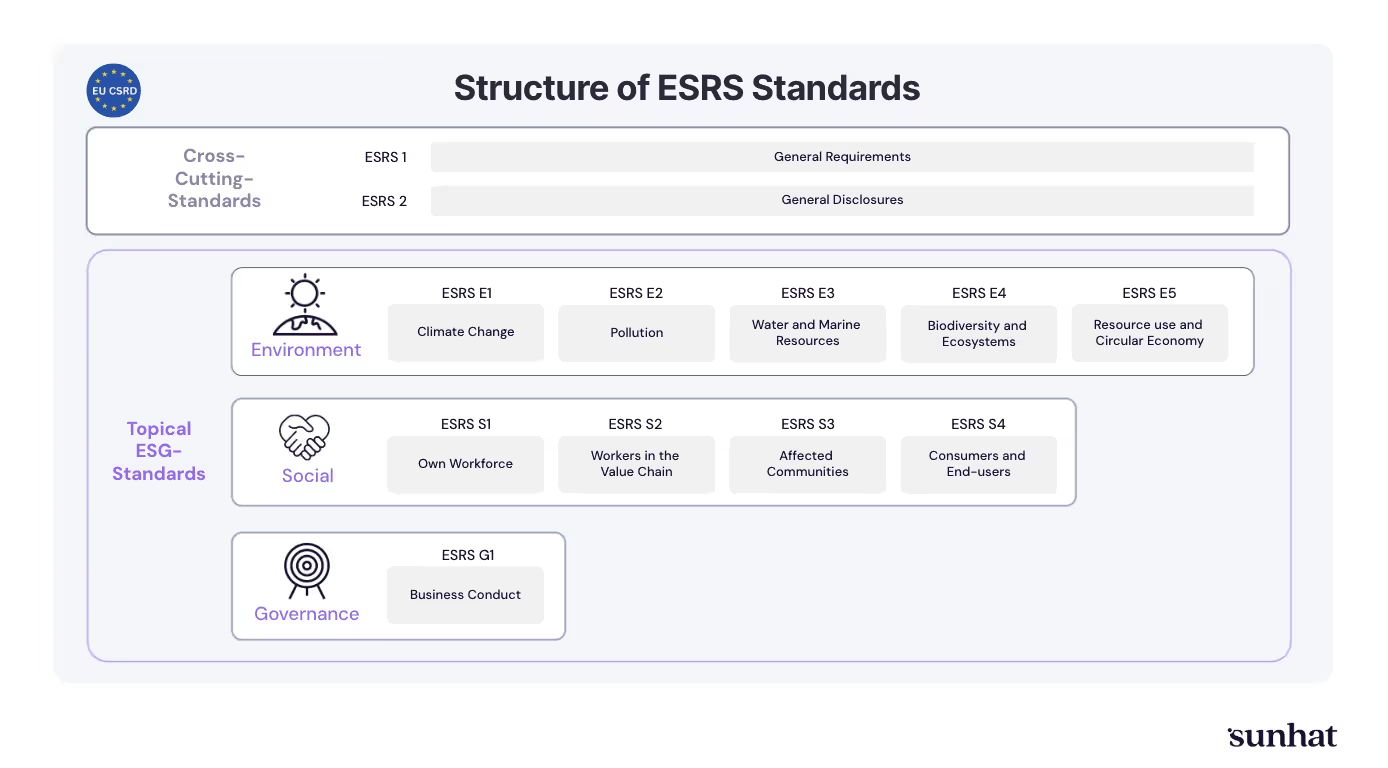
While the CSRD can be seen as the Law, the ESRS represents the Language of the reporting standard. The ESRS (EU Sustainability Reporting Standards) encompass a wide range of reporting areas, offering guidance across cross-cutting (general) and topical (environment, social, governance) standards.
Note: The revised ESRS were adopted by the European Commission on 3 July 2026, cutting data points, clarifying requirements and aligning with other legislation. The delegated act is now in the two-month European Parliament and Council scrutiny period before it enters into force and applies from financial year 2027 (with voluntary early adoption possible from FY2026).
There are a total of 12 standards, each outlining how companies should report on specific subject areas. By focusing on the sustainability matters relevant to their operations, companies will track and disclose designated data points within the reporting topics.
- 2 cross-cutting standards
- 5 topical environmental standards
- 4 topical social standards
- 1 topical governance standard
The EFRAG ID 177 Mapping
The Corporate Sustainability Reporting Directive (CSRD) aims to make sustainability reports comparable and transparent. However, given the complexity of the requirements and recent regulatory updates, companies often find it challenging to determine exactly which data points must be reported following their Double Materiality Analysis (DMA).
To address this, EFRAG published Explanation ID 177, a tool specifically designed to clarify the link between sustainability matters (topics, sub-topics, and sub-sub-topics) and the relevant Disclosure Requirements (DRs) of the ESRS. This mapping acts as a bridge, supporting companies to translate the results of their materiality assessment into the specific metrics and qualitative disclosures required by the standards.
It is important to note that while ID 177 is still widely used and remains the current technical reference for the 2025 reporting cycle, it is considered a "pre-simplification" tool. The Omnibus simplification package, finalized in early 2026, has introduced significant reductions in data points to streamline disclosures. While the original mapping is still technically valid today, companies should anticipate an updated version from EFRAG later this year to align with the revised, post-Omnibus standards.
Double Materiality & Value Chain: The Heart of CSRD
The Double Materiality Assessment (DMA) is the mandatory filter for the entire sustainability statement. It ensures companies only report on what truly matters, while the latest value chain reliefs provide a pragmatic "phase-in" period for complex supply chain data.

The Double Materiality Process
Unlike traditional reporting, CSRD requires companies to look in two directions. First, they need to identify Impact Materiality and Financial Materiality.
Impact materiality: Impact on people and environment
- How your company’s actions affect people and the planet over the short, medium and long term, including the impacts of your entire value chain.
Financial materiality: Impact on company value
- How sustainability matters impact your company’s development and financial performance in the short, medium and long term.
Under the 2026 guidelines, if a topic is not material under either perspective, companies are generally not required to disclose it, significantly reducing the overall reporting burden. CAUTION: For ESRS E1 (Climate Change), companies that deem it non-material must provide a detailed explanation of why.
The Value Chain Relief
Value chain reporting requires companies to look beyond their own operations and disclose the environmental and social impacts of their entire business network, from raw material sourcing to product disposal. Collecting this granular data from hundreds of suppliers is arguably the most significant challenge of CSRD compliance. To address this, the 2026 Omnibus I Directive formalizes a three-year transitional relief period.
For the first three years of reporting, companies may omit granular value chain data—including Scope 3 emissions—if the information is not "readily available." Instead of providing hard data, companies are required to describe their "reasonable efforts" to obtain it and outline a clear action plan to improve data quality in the future. This transition period is designed to give both reporting companies and their smaller suppliers the necessary time to build robust data-sharing infrastructure.
Preparing for CSRD Reporting: Managing Data Challenges
Moving from voluntary disclosures to mandatory CSRD compliance significantly increases the data burden. Keeping track of over hundreds of ESRS datapoints is a cross-functional data challenge that requires accuracy, consistency, and "audit-ready" proof.
CSRD reporting typically involves three layers of complexity:
- Decentralized Data Collection: Gathering information from HR (Social), Procurement (Value Chain), and Facility Management (Environmental).
- Technical Data Analysis: Performing complex calculations for CO₂ equivalents, circular economy metrics, and financial risk modeling.
- Audit-Ready Preparation: Formatting narrative and quantitative data to meet the specific requirements of the ESRS.
The biggest challenge for companies is Proof Management: the ability to find, verify, and document the specific evidence required for limited assurance. Without a centralized system, companies face a Proof Gap: the space between knowledge and being able to prove it.
Using AI to Bridge the Proof Gap
In 2026, AI has become a critical tool for ESG managers to handle this complexity. By using AI to analyze historical data and automatically map internal evidence to specific ESRS questions, teams can reduce manual effort by up to 50%. Advanced ESG software such as Sunhat’s Collaborative Proof Platform support by suggesting draft responses, identifying data gaps, and building an extensive in-house "Answer Library" that ensures your reporting is consistent year-over-year.
While AI handles the heavy lifting of data mapping and drafting, Sunhat ensures human oversight remains central to the process. Our platform provides a collaborative workspace where experts can verify "Proof". ensure that every disclosure is backed by a transparent audit trail and ensure to avoid non-compliance with the latest EU regulations.
Mandatory Digital Tagging (iXBRL)
To ensure transparency and machine-readability across the EU, the CSRD mandates that companies prepare their sustainability statements in a strictly digital format. Under this requirement, companies must "tag" their ESG disclosures using the Inline XBRL (iXBRL) standard, integrated into the European Single Electronic Format (ESEF).
This process involves converting narrative and quantitative data into a structured digital language, allowing investors and regulators to extract and compare information across different companies automatically. By adopting this digital-first approach, companies ensure their reports are audit-ready and fully compatible with the upcoming European Single Access Point (ESAP), a centralized database for EU corporate information.
The Consequences of Non-Compliance
While the EU provides the framework, national regulators (such as BaFin in Germany) enforce specific penalties. In 2026, the consequences are split between legal sanctions and more market-driven risks.
Legal & Regulatory Sanctions
Under finalized national laws (e.g., the German CSRD-UG), companies face:
- Financial Penalties: Fines can reach significant amounts, often tied to a percentage of annual turnover (e.g., up to 5% of global turnover or €10 million for serious violations).
- Public Naming and Shaming: Regulators publish a statement on their website identifying the company and the nature of the breach, significantly damaging brand reputation.
- Cease and Desist Orders: A mandate to halt the specific business activities or reporting practices that led to the non-compliance.
Market-Driven Consequences
Beyond legal fines, non-compliance in 2026 triggers:
- Loss of Access to Capital: Banks and investors now use CSRD data as a prerequisite for green financing. Non-compliance can lead to higher interest rates or total exclusion from ESG-linked funds.
- Supply Chain Delisting: Large "Wave 1" companies now require CSRD-compliant data from their partners. Failure to provide this data may result in being removed from major supplier networks.
Conclusion: Turn CSRD Reporting into Your Strategic Advantage
The transition to CSRD reporting represents a fundamental shift toward a more transparent and resilient global economy, moving far beyond a mere regulatory hurdle. Although the initial complexity of the ESRS standards may be overwhelming, companies that view these requirements as a strategic framework rather than a compliance checklist will be better positioned in the evolving market.
Using the Omnibus I simplifications allows companies to focus their resources on data points that are truly material to their business model, avoiding the "compliance noise" of unnecessary disclosures. Furthermore, reporting to voluntary standards like the VSME enables companies to share data with their supply chain partners, fostering stronger, more reliable business relationships.
The ultimate goal is to demonstrate credible, data-backed sustainability performance that meets EU mandates and secures a competitive advantage in an increasingly ESG-conscious capital market.
Frequently Asked Questions
The CSRD applies to a broad range of entities, primarily targeting large EU-based companies and non-EU groups with significant turnover within the European Union. Generally, if a company exceeds specific thresholds for employee count, net turnover, and balance sheet totals for two consecutive years, it falls within the mandatory reporting scope. Smaller entities, often called "Small Mid-Caps," may not be legally required to report fully but often utilize simplified voluntary standards (like VSME) to meet data requests from larger customers in their supply chain.
Double Materiality is the mandatory "filter" used to determine which sustainability topics a company must disclose. It requires companies to report on two perspectives:
- Impact Materiality: How the company’s actions affect people and the planet.
- Financial Materiality: How sustainability matters (like climate change or resource scarcity) impact the company’s financial performance and value. If a topic is deemed non-material under both lenses, it can typically be omitted, though critical areas like Climate Change (ESRS E1) usually require a formal explanation if they are excluded.
The European Sustainability Reporting Standards (ESRS) provide the technical framework and "language" for CSRD disclosures. The framework consists of 12 standards divided into two categories:
- Cross-cutting Standards: The two general standards (ESRS 1 and 2) with requirements and disclosures applicable to all reporting.
- Topical Standards: The ten standards covering Environmental (e.g., Climate, Pollution), Social (e.g., Own Workforce), and Governance (e.g., Business Conduct) factors.
Under the CSRD, companies must look beyond their own operations to disclose the environmental and social impacts of their entire business network, from raw material sourcing to product disposal. Because gathering this granular data from suppliers is complex, the directive includes a three-year transitional relief period. During this phase, companies may omit certain supply chain data (like Scope 3 emissions) if it is not "readily available," provided they describe their "reasonable efforts" to obtain the data and their plans for future improvements.


Free Roadmap: Your Path to Successful CSRD Reporting
Stop guessing and start reporting. Get the exact steps needed after Omnibus I to finalize your ESRS-compliant report.




.avif)











%201.svg)