
Latest update on May 11, 2026
[cg_add-class=heading-style-h4]In a Nutshell
- Updates in 2026 aim to improve how companies disclose information by providing a more refined structure and clearer guidance.
- Global asset managers and policymakers are increasingly using CDP data to differentiate long-term investments and design effective regulations.
- CDP is evolving in step with major global frameworks like the TNFD, GRI, and the GHG Protocol to ensure a "write once, read many" approach that reduces the overall reporting burden.
- Using a Collaborative Proof Platform such as Sunhat can significantly simplify the process and reduce errors
Watch on-demand webinar now!
.avif)
Our experts Liisa Kelo and Alexander Beer walked through every meaningful change in the 2026 disclosure cycle in our May 2026 webinar. The practical insights from that session inform the updates below.
CDP 2026: Bridging the Gap Between Data and Action
As a voluntary yet globally recognized disclosure system for environmental transparency, CDP maintains the most extensive database of corporate and municipal environmental impact data. The foundation of this system is an annually updated, integrated questionnaire that defines how organizations report their environmental data.
The 2026 CDP disclosure cycle marks a major shift towards a more comprehensive, nature-positive reporting landscape. As organizations face accelerating climate impacts and biodiversity loss, the market's need for high-quality, comparable intelligence is at an all-time high. CDP is evolving to meet this demand, focusing on strengthening the link between the data organizations report and the environmental actions they take.
Quick Analysis: Find Your Biggest CDP Gaps
Upload last year's CDP response (Word or PDF). Drawing on our experience as CDP Accredited Solutions Provider, we show you the areas you're having the biggest gaps — across Climate Change, Water and Forests.
Your data stays yours. The file you upload is read directly in your browser. It is never sent to, or stored on, our servers. We only receive your contact details and a short summary of your result so our team can follow up if you want them to.
Core Updates for CDP Questionnaire 2026
1. The Debut of Ocean Disclosure
Recognizing the vital role of marine ecosystems in global economic stability, CDP is introducing ocean-related questions for the first time:
- Who it's for: All organizations using the full corporate questionnaire can "opt-in".
- Scoring: This content will not be scored in 2026, giving companies time to establish data collection processes.
In response to strong market demand and emerging regulations, CDP is expanding its framework to include the ocean, enabling organizations to surface critical data on the blue economy and marine biomes. This integration bridges a significant reporting gap, providing capital markets with the transparency needed to drive corporate action and protect vital aquatic ecosystems.
2. Expanded Forests & Nature Scope
CDP is broadening its forests coverage to include commodities with significant deforestation and conversion impacts:
- New Scored Commodities: Cocoa, coffee, and rubber join timber, palm oil, cattle, and soy as scored commodities.
- Unified Scoring: All seven commodities will now contribute to a single, comprehensive forests score. Since they are all scored together now, one weak link can drag down the whole forest score.
CDP aims for a comprehensive reporting landscape where organizations manage all land-related dependencies and risks, specifically focusing on the elimination of ecosystem conversion within global supply chains. By prioritizing high-impact commodities like cattle, timber, cocoa, and rubber, the framework aligns with AFi and SBTN standards to drive transparency in protecting forests and natural ecosystems.
3. Enhanced SME Experience
Small and Medium Enterprises (SMEs) are seeing significant upgrades to their reporting journey:
- The "A List" is open: For the first time, leading SMEs can achieve an "A" score for Climate Change (previously capped at "B").
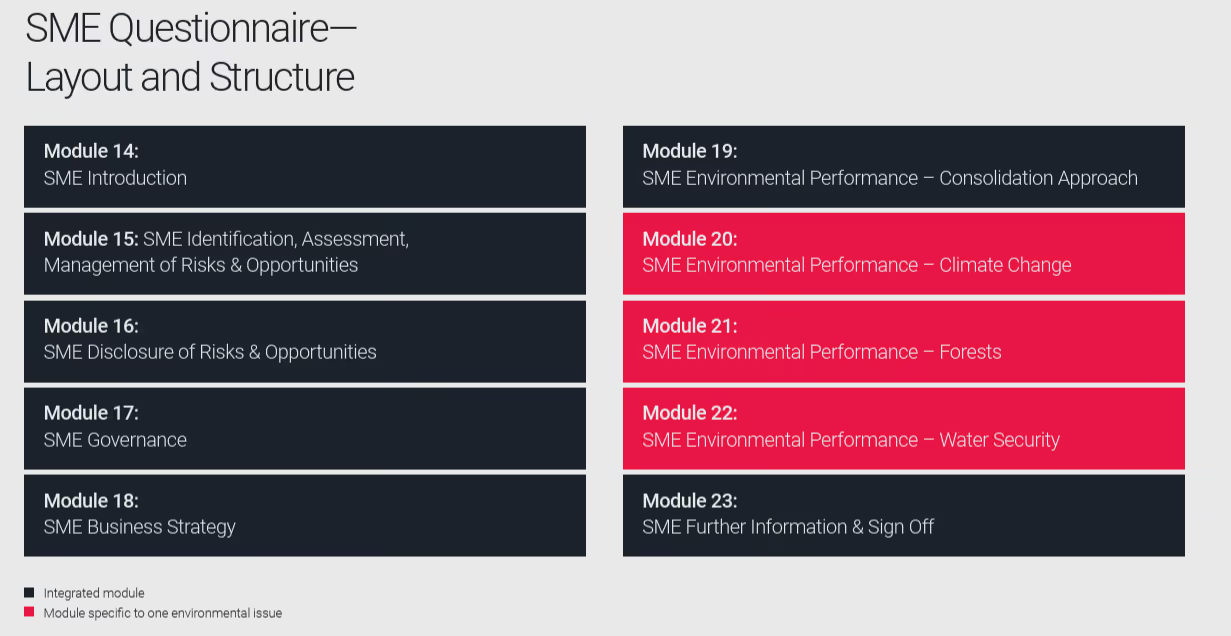
- New Nature Modules: SMEs can now disclose on Forests and Water Security through new (unscored) modules. The SME questionnaire now consists of 10 instead of 8 modules.
4. Continuous Framework Alignment
CDP is pursuing a "write once, read many" approach:
- Updates to the 2026 questionnaire will strengthen the alignment with the TNFD recommendations, the GRI 303 Water & Effluents standard and the GHG Protocol Land Sector and Removals Guidance.
- Data disclosed once through CDP can be used to meet multiple market, regulatory and investor requirements while enabling disclosers to reduce their reporting burden.
New Metrics to Track
Before you start the 2026 disclosure cycle, be aware of some specific new data points:
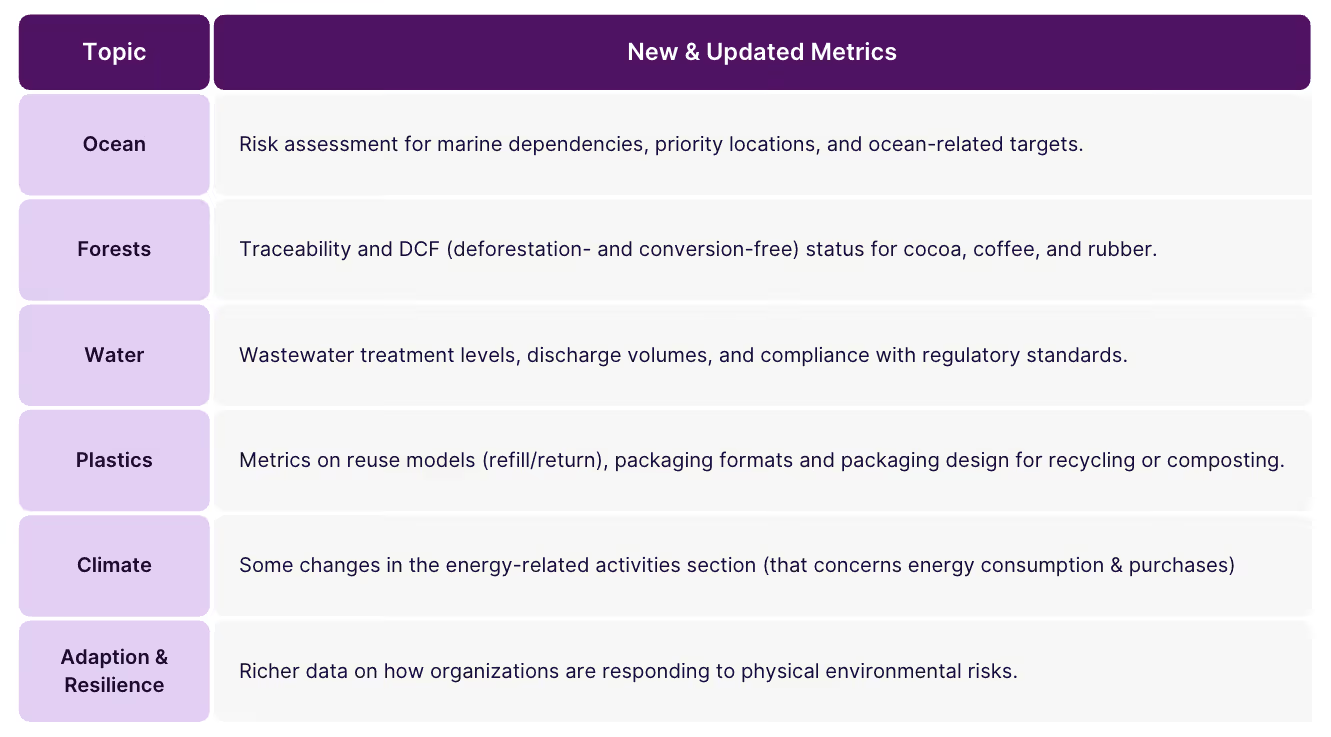
You can find the official key changes to the 2026 questionnaire here: Preparing for CDP’s 2026 disclosure cycle (as of Feb 2026).
What Tightens in Modules 4, 5, and 7
Beyond the headline updates, three changes inside the core modules can shift your 2026 score even if the rest of your disclosure stays consistent with last year.
Transition plans must cover adaptation, not just mitigation
Modules 4 and 5 expect explicit treatment of how the organization prepares for physical climate impacts, including extreme weather, resource scarcity, and supply chain disruption. CDP also splits the previous single business-impacts question into two: one for strategy, one for operational financial planning. The intent is to replace qualitative narrative with concrete financial figures comparable across companies. Broad qualitative statements in these modules score lower in 2026 than they did in 2025.
Scope 3 exclusions move from free text to dropdown
Companies can no longer mark a Scope 3 category as "not relevant" with an open-text justification. CDP now requires a standardized reason from a dropdown menu, supported by a short explanation field. The change closes a common path to omitting categories without analytical scrutiny and forces a consistent rationale that data users can compare across disclosers.
Energy reporting captures the full decarbonization mix
Low-carbon electricity now sits in a separate line from heat, steam, and cooling. A new line also captures non-renewable zero-emission sources such as nuclear and carbon capture and storage. The breakdown gives data users a clearer view of which technologies organizations rely on for their emissions reductions, and reflects CDP's alignment with the GHG Protocol Land Sector and Removals Standard for land-based activities.
Key Essential Criteria (EC) Updates for 2026
In 2026, CDP is not adding any entirely new essential criteria but is introducing several revisions to clarify existing requirements and reflect the updated questionnaire structure. These baseline requirements ensure a consistent minimum standard for transparency and environmental stewardship across all scoring levels.
Climate Change
- Risk Management (EC-CC1 & EC-CC2):
- Leadership Requirement: Organizations must demonstrate high-quality processes for identifying and managing environmental risks to qualify for "A" or "A-" (Leadership) scores.
- Executive Incentives (EC-CC4):
- Compliance Flexibility: Provides a new pathway for state-owned entities or those with legal restrictions, ensuring they aren't unfairly penalized for being unable to offer financial incentives.
- Verification pathway for European reporters:
- ESRS reports are accepted as valid third-party verification of emissions data for the Leadership pathway. Scope 1, Scope 2, and at least one Scope 3 category must be in the assurance scope. For companies already preparing for ESRS, this removes a duplicate verification step that previously caused friction in the CDP submission.
Water
- Tailings Dams (EC-W3 & EC-W4):
- Sector-Specific Reporting: (Coal, Metals & Mining) Now requires structured data columns instead of text fields. This is a technical requirement for data comparability.
- Risk Assessment (EC-W5):
- Quality Focus: Moves away from specific tool/risk type mandates to emphasize high-quality assessments across the entire value chain and multiple time horizons.
Forests
- Commodity Scope (EC-F12):
- Scoring Expansion: Cocoa, coffee, and rubber are now subject to the same strict criteria (exclusions, origin, targets, traceability) as the original four commodities.
- Disclosure Threshold (EC-F3):
- Eligibility Flexibility: The "small volume" exclusion threshold has increased from 1% to 5%, allowing organizations to focus resources on more significant forest-risk commodities.
- Risk Assessment (EC-F4):
- Quality Focus: Similar to Water, specific tool requirements are removed to prioritize comprehensive assessments across the entire value chain.
Note: The shift in EC-F4 and EC-W5 suggests a move toward "principled" reporting—where the depth and reach of your assessment matter more than which specific software or tool you used to conduct it.
Practical Tips for Responding Efficiently to the CDP Questionnaire in 2026
1. Start preparing at an early stage
Answering the CDP questionnaire requires close cooperation between different departments. Even if the submission is not due until mid-September, the preparation process should start early. Structured planning helps to avoid bottlenecks and improve data quality.
A) Gap analysis: where were gaps or problems in the last CDP scoring?
Before companies start collecting data, it is worth taking a detailed look at the last questionnaire submitted and the CDP scoring. Important steps:
- Evaluation of previous year's answers: Which questions were only partially or insufficiently answered?
- Scoring analysis: Which aspects contributed to the score or caused deductions?
- Comparison with current CDP requirements: Are there new priorities or stricter evaluation criteria?
- Identify optimization potential: Where can processes or data quality be improved?
Companies aiming for a better rating should pay particular attention to areas in which they received no or only limited points last year — for example, in climate strategy or the verification of emissions data. As a CDP Accredited Solutions Provider, we are familiar with typical weaknesses in scoring and can provide targeted support for optimization, as well as properly considering the updates of the 2026 disclosure cycle.
B) Collect & update ESG data
ESG data collection is one of the most time-consuming steps in the CDP process. It is particularly challenging to collect consistent and verified data from various company divisions and external sources:
- Identify relevant data sources: Which systems (e.g. energy reports, sustainability platforms) contain the required information?
- Calculate Scope 1, Scope 2 and Scope 3 emissions: For many companies, recording and validating Scope 3 emissions (indirect emissions from the value chain) is the biggest challenge.
- Standardize sustainability indicators: Uniform definitions and measurement methods facilitate reporting and prevent inconsistencies.
- Observe Essential Criteria: CDP specifies minimum requirements for various questions that companies must fulfill in order to receive points. For example, an answer on climate strategy often requires detailed information on targets, measures, and progress measurement.
Tip: Companies with complex value chains should contact suppliers at an early stage in order to obtain the necessary data for Scope 3 balancing.
C) Gathering documents & evidence
Unlike EcoVadis, CDP does not typically ask for specific evidence for every claim. Instead, it relies on your organization's integrity, with two primary "hard" requirements for documentation:
- Environmental Policy: Your overarching framework for environmental management.
- Verification Proof: External auditor reports from your annual reporting that validate your data.
It is particularly important for companies aiming for a CDP A rating to be able to provide verifications. From 2024, full verification of Scope 1 and Scope 2 emissions will be mandatory — anyone wishing to achieve an A grade must also have at least one Scope 3 category externally verified.
2. Keep an eye on important deadlines
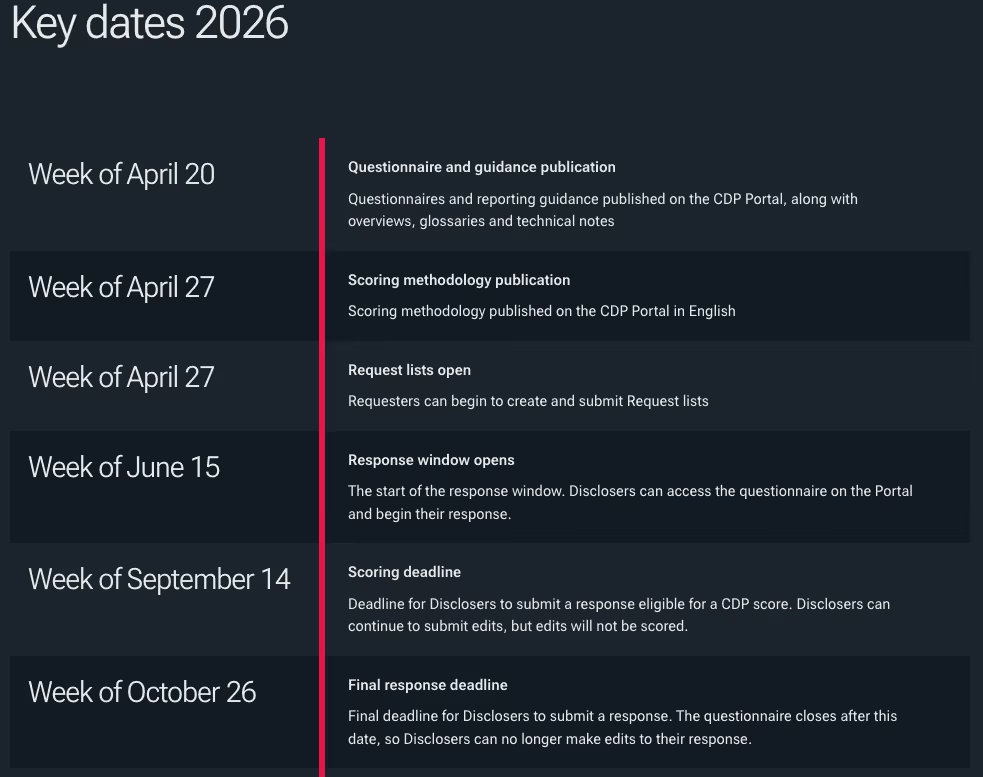
CDP sets a uniform deadline for all companies. Although the exact date for 2026 has not yet been published, the deadline is the week of September 14, 2026.
Tip: Schedule a sanity check 2-4 weeks before submission to avoid mistakes!
3. Avoid the most common pitfalls
Many companies lose valuable points due to avoidable errors in the questionnaire. Pay particular attention to the following stumbling blocks:
- Unfilled tables: Tables must be completely filled in, otherwise they will remain marked as "in progress".
- Use correct units: Check whether your internal data matches the CDP specifications.
- Observe response logic: Follow-up questions may be activated if you give certain answers.
Tip: CDP will increasingly check whether information on climate-related risks is consistent with financial reports and sustainability strategies.
4. Use CDP guidance effectively
CDP provides detailed guides for the individual question categories. These guides help you to better understand the requirements and to formulate answers correctly. Click here for the guides from the CDP Helpdesk.
Why ESG Software Makes the CDP Process Easier
Answering the CDP questionnaire is time-consuming and requires accurate and consistent data collection. Sunhat's Collaborative Proof Platform helps companies to make this process more efficient and significantly reduce the workload.
1. Automated data processing & intelligent linking
- Leveraging Answers Across ESG Frameworks: Sunhat enables answers from one ESG framework, such as CDP or ESRS, to be leveraged across others that ask similar questions. This allows for the targeted reuse of existing information, reducing the need for redundant data entry.
- Tagging & search function: The targeted tagging of answers means that relevant content can be found in the shortest possible time and used efficiently.
2. Optimized collaboration & error reduction
- Project management functions: Tasks can be clearly assigned, progress tracked and errors avoided thanks to a structured system — without time-consuming coordination by email.
- Versioning & data history: Previously submitted responses are saved and can be tracked and adjusted for future reporting cycles.
- Expert collaboration: Directly bring topic experts into the tool to provide data at the source, which is often not so easy to accomplish directly in the CDP portal.
3. Direct submission to the CDP portal
New for the 2026 cycle: Sunhat connects directly to the CDP portaI. Once your responses are reviewed and approved in our Collaborative Proof Platform, we transfer them to CDP without copy-paste. This removes the most common source of last-mile error in the disclosure process and gives sustainability teams hours back at the deadline.
With Sunhat as CDP Accredited Solutions Provider you can make the CDP process more structured and time-saving, avoid redundancies and sustainably optimize your ESG reporting.
Prepare now & keep an eye on deadlines!
It's Time to Prove
What You Already Do
Your next questionnaire, assessment, or audit meets traceable proof.
With Sunhat, you verify your evidence once, then reuse it everywhere.
See how you can get there.



Frequently Asked Questions
The CDP 2026 questionnaire is mandatory to be filled out for large companies that are either invited to participate or wish to disclose voluntarily. Listed companies, companies from resource-intensive sectors (such as energy, chemicals and the automotive industry) and companies with a significant environmental impact are particularly affected. In addition, companies that aim to make sustainable investments may also be required to participate.
The 2026 CDP questionnaire introduces a new Ocean disclosure module, expands Forests scoring to include cocoa, coffee, and rubber, and enables SMEs to achieve "A List" status for the first time.
The deadline for submitting the 2026 CDP questionnaire is the week of September 14, with an exact date to be announced.
Scope 1 emissions arise directly within the company, Scope 2 emissions are caused by electricity consumption, and Scope 3 emissions encompass the entire supply chain and external activities.
Yes, provided emissions data is explicitly within the audit scope. CDP checks the audit note to confirm which scopes were covered. If your assurance covers only financial line items, it will not satisfy the verification requirement for Leadership scoring.
The disclosure threshold rose from 1% to 5% of revenue per commodity in 2026. If cocoa, coffee, or rubber accounts for less than 5% of your revenue, you may now fall below the inclusion line. Above that threshold, the same strict criteria for exclusions, origin, targets, and traceability apply as for palm oil, soy, timber, and cattle.


Improve Your CDP Rating with Our CDP Checklist!
Get our practical checklist to identify gaps, strengthen your ESG data and boost your CDP score with confidence.




%201.svg)