

Key Takeaways
Latest Update on April 13, 2026
- Single EU-wide regulation. The Packaging and Packaging Waste Regulation (Regulation (EU) 2025/40) replaces the old Packaging and Packaging Waste Directive with one mandatory rulebook across all 27 member states. No national transposition, no country-by-country variation.
- August 12, 2026 is the first hard deadline. From that date, every unique packaging type placed on the EU market needs a signed Declaration of Conformity (DoC) backed by technical documentation. Products without one cannot legally enter the market.
- Obligations depend on your role, not your location. Whether you manufacture, import, or distribute packaging, the PPWR assigns specific duties. Many companies hold multiple roles at once and do not realise it.
- Compliance is a data problem. Most companies already meet the physical requirements. The gap is proving it: collecting verified substance test results, recycler certificates, and full material breakdowns from every supplier in the chain.
What Is the Packaging and Packaging Waste Regulation (PPWR) and Why It Is Different From What Came Before
The Packaging and Packaging Waste Regulation (EU) 2025/40 (PPWR) is a mandatory framework for all EU member states. It replaces the Packaging and Packaging Waste Directive 94/62/EC and shifts the industry from voluntary targets to mandatory performance standards. It is important to understand why this regulation requires a different response than the rules that came before it.
From a Patchwork of National Rules to a Single Rulebook
The most important change is the shift from a directive to a regulation. Under the old PPWD, each member state wrote requirements into national law. This created a patchwork of rules. France required the Triman symbol, Germany operated LUCID, and Italy used its own codes. Companies selling in multiple markets faced different rules and reporting timelines in every territory.
PPWR ends this fragmentation. As a regulation, it applies to all 27 member states at the same time. There is no national variation. For products placed on the market after August 12, 2026, there is no grace period.
What This Means for Companies on National Systems Today
The scale of the problem is clear. Packaging waste in the EU reached 177.8 kg per capita in 2023 according to Eurostat/JRC. The PPWR shifts the financial and operational responsibility for this waste directly onto producers.
For companies managing packaging through national systems like Germany's VerpackG, PPWR is a structural change. National laws do not vanish immediately, but PPWR takes precedence. You must now assess your packaging against unified EU requirements rather than individual country rules.
Enforcement is driven by market surveillance authorities in each member state. If requested, the European Commission can demand full technical documentation within 10 days. In a post-PPWR market, being unable to provide proof means losing market access. Distributor contracts cannot be fulfilled, and non-compliant products will be withdrawn from shelves
Manufacturer Obligations: Am I in Scope of the PPWR?
Understanding your specific liability and manufacturer obligations is the first step toward compliance. Most expensive regulatory mistakes happen when companies misidentify their role.
Are you in Scope? Use our PPWR Role Finder to find it out.
The Threshold for Obligation
The PPWR applies to all economic operators placing packaging on the EU market. Specific obligations target producers with more than 10 employees and over €2 million in annual revenue. While companies below both of these thresholds have minimal exemptions in specific cases (micro-enterprise exemption), the core requirements apply to almost everyone above them.
The regulation follows the product to market idea. Your manufacturing location is irrelevant. Your obligation is determined by where your product is sold.
The Manufacturer Definition Many Companies Get Wrong
A common error is assuming the manufacturer is the company that physically makes the packaging. Under the PPWR, this is not the case.
The manufacturer is the company that determines the packaging specifications. If you design the packaging, specify the materials, or put your trademark on it, the regulation views you as the manufacturer of the packaging.
This catches brand owners and retailers with own-label products off guard. The factory that produced the packaging holds no responsibility in this case, the retailer does. Supplier contracts that attempt to shift this responsibility do not change your legal position under the PPWR. If your name is on the packaging, you own the obligation.
Role Breakdown in the Value Chain
Liability flows through the value chain. Your specific duties depend on your role:
- Manufacturers: Hold responsibility for design and conformity. They must own the Technical Documentation file and sign the Declaration of Conformity.
- Importers: Must verify supplier compliance and documentation before placing products on the EU market. Legal accountability sits with the importer, not a non-EU factory.
- Distributors: Responsible for checking packaging, not for the underlying documentation. They must verify labels and refuse to sell non-compliant items.
- Producers and Brand Owners: Must complete EPR registration in every member state where their products are sold. They carry financial obligations in every market where the product appears.
The PPWR Timeline
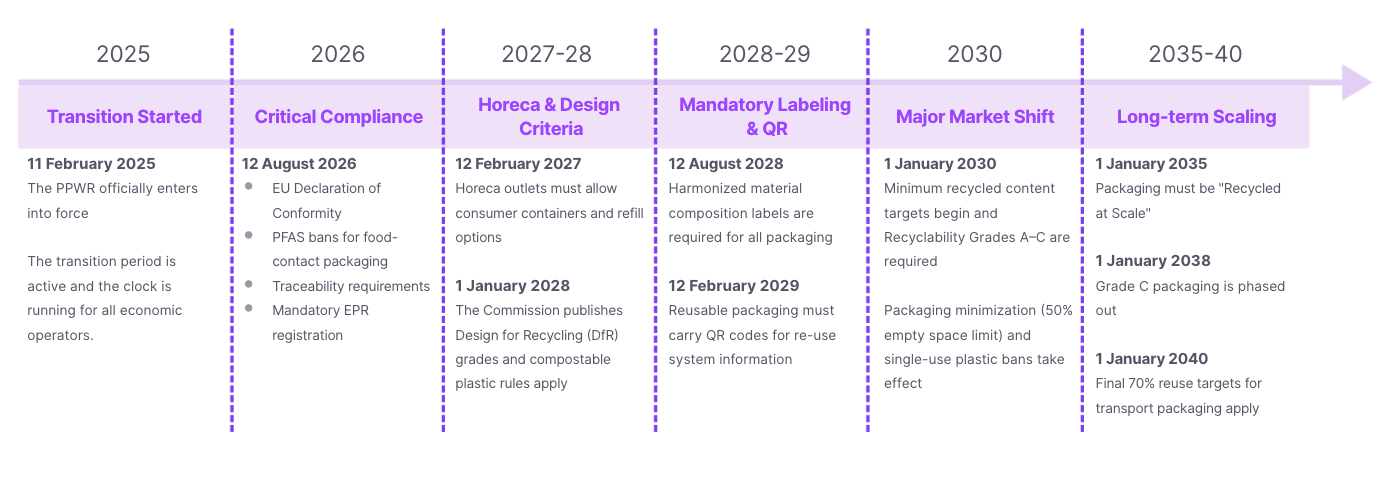
PPWR is not a single deadline. It is a phased regulation with obligations stretching from 2026 to 2040. As of April 2026, 29 delegated acts from the European Commission are still outstanding. This means many technical details, such as the exact Design for Recycling (DfR) criteria and the methodology for recyclability grading, are not yet defined.
These criteria are expected by the 2028 milestone. Companies currently planning packaging redesigns for 2030 are working against technical specifications that do not fully exist. This uncertainty is not a reason to delay action. Instead, you must build flexibility into your current design decisions and partner with experts who track the delegated act pipeline.
What PPWR Actually Requires You to Prove
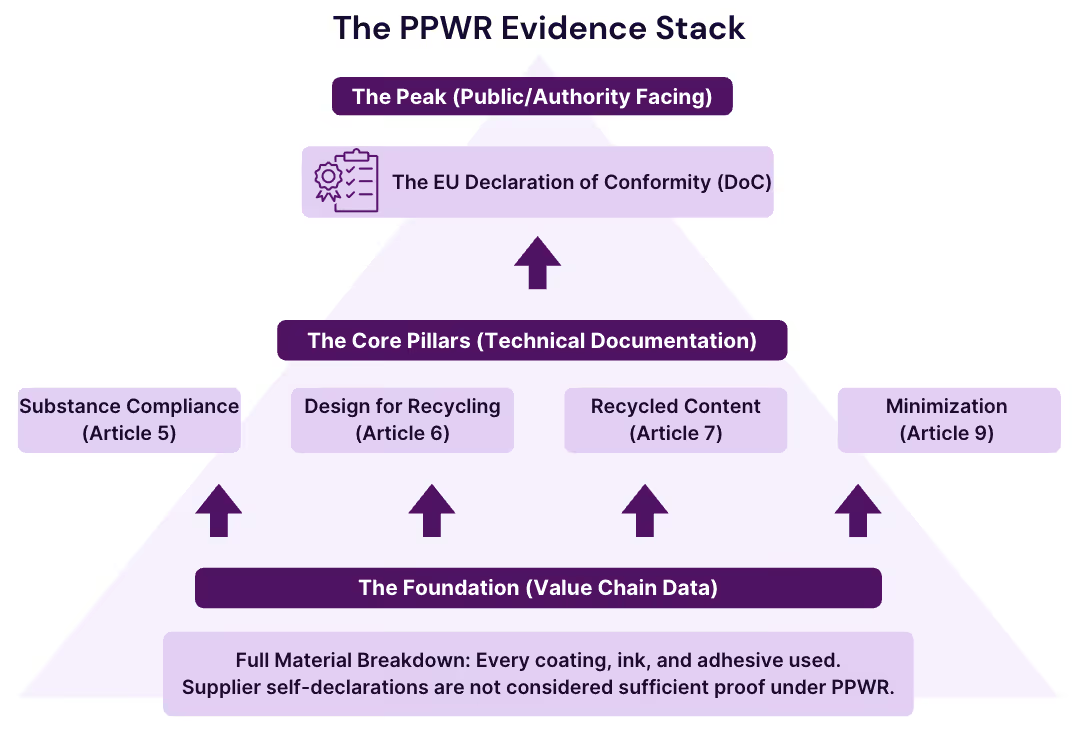
Translating a complex regulation into a practical proof inventory is the only way to move from uncertainty to readiness. PPWR compliance focuses on five core pillars: documentation, substance limits, recyclability, recycled content, and producer responsibility.
The EU Declaration of Conformity (DoC)
From August 12, 2026, every unique packaging type placed on the EU market must have a signed Declaration of Conformity. This is a legally binding self-declaration where the manufacturer or importer confirms the packaging meets all sustainability requirements.
- Who Signs: The company that determines the packaging specifications or places their brand on the packaging.
- Accountability: A generic "compliance certificate" from a supplier is not enough; you are personally and legally responsible for the accuracy of the DoC you sign.
- Aggregation: You may aggregate declarations for materially identical packaging types, but the underlying technical documentation must remain specific to each item.
The Technical Documentation File
The technical documentation is the evidence package that backs up every claim in your DoC. It must be kept available for 5 years for single-use packaging and 10 years for reusable packaging. Elements of this documentation are:
Substance Compliance (Article 5)
This is your immediate priority as it takes effect in August 2026.
- PFAS Restrictions: For food-contact packaging, PFAS levels must be below 25 ppb (individual) or 250 ppb (sum).
- Heavy Metals: The combined total of lead, cadmium, mercury, and hexavalent chromium must not exceed 100 mg/kg across all packaging types.
Recyclability and Design for Recycling (Article 6)
By 2030, all packaging must be designed for recycling and achieve at least Grade C performance (70% recyclability).
- Performance Tiers: Grade A (≥95%), Grade B (≥80%), and Grade C (≥70%).
- Proof Points: Documentation must include conformity results using the DfR methodology, specifically sorting compatibility and ease of dismantling.
Recycled Content Proof (Article 7)
Plastic packaging must meet mandatory post-consumer recyclate (PCR) thresholds starting in 2030.
- PCR vs. PIR: Only post-consumer recyclate (recovered after use by consumers) satisfies these targets. Production waste (PIR) does not count toward these specific thresholds.
- Targets: For example, 30% PCR for PET beverage bottles by 2030, rising to 65% by 2040.
Packaging Minimization (Article 9)
Manufacturers must prove that packaging weight and volume have been reduced to the minimum necessary for functionality.
- Justification Report: You must provide a written report explaining why further reduction is impossible without compromising safety or hygiene.
- Prohibited Reasons: Marketing volume or "perceived value" (e.g., double walls or false bottoms) are not valid justifications.
EPR Registration and Labeling Requirements
- EPR Registration: You must register in the national producer registry of every member state where you operate. There is no single EU-wide registration.
- Harmonized Labeling: By August 12, 2028, packaging must bear unified material composition labels to aid consumer sorting. Reusable packaging requires a QR code for re-use information by February 2029.
What Non-Compliance Costs
Market access is the primary enforcement mechanism of the Packaging and Packaging Waste Regulation, not financial penalties. If you cannot prove your readiness by August 2026, you cannot legally place your packaging on the EU market. This will lead to blocked product launches and the withdrawal of existing stock.
Liability flows through the entire value chain. Non-compliance by a single supplier creates immediate exposure for brand owners and importers. Under Articles 55 to 61, specific fines are managed locally by each member state and are not yet determined in most countries.
Beyond fines, companies face high hidden costs. A single PFAS analysis starts at several hundreds and can run into the tens of thousands of euros, and the R&D investment required to meet mandatory recyclability standards adds up fast.
DoC, DPP, CSRD and the Data You Build Once
Three distinct regulatory requirements sit at the center of EU packaging transparency, but they all rely on the same underlying material data. Building a clean data infrastructure now allows you to fulfill current obligations while automatically preparing for what comes next.
DoC vs. DPP: Proof for Today and Transparency for Tomorrow
The Declaration of Conformity (DoC) is your immediate legal priority for August 2026. It is a static, product-specific document that proves to authorities that your packaging meets current PPWR requirements.
The Digital Product Passport (DPP) is the next phase of this transparency effort, expected around 2027 under the ESPR framework. Unlike the DoC, the DPP is a dynamic, publicly scannable dataset accessed via QR code. It provides consumers and recyclers with detailed material breakdowns, PCR content, and recyclability grades.
Because the DPP requires the same raw inputs as your technical documentation file, companies that structure their data correctly today will have already completed roughly 90% of their future DPP preparation.
The CSRD Connection
This same data infrastructure directly supports your CSRD reporting. Packaging material composition, recycled content, and recyclability assessments map precisely to ESRS E5 (Circularity and Waste Management). By building your verified data baseline once, you eliminate redundant collection exercises and ensure consistency across both your regulatory proof and your sustainability disclosures.
How to Solve the Supplier Data Problem
Most gaps in PPWR compliance are not caused by packaging that fails to meet requirements. They are caused by missing or unstructured data from the value chain. You cannot sign a Declaration of Conformity without verified substance test results, recycler certificates of origin for PCR content, and full material breakdowns including every coating, ink, and adhesive used. Under the PPWR, supplier self-declarations do not count as proof.
The Data Challenge at Scale
For producers managing thousands of products across multiple sites and ERP systems, data quality varies enormously. Some locations maintain detailed specifications, while others have only basic article numbers. Building a complete, verified baseline from this fragmented environment is a prerequisite for compliance, yet for most companies, that baseline does not exist today.
How Sunhat Helps You Prove It
Sunhat is the Collaborative Proof Platform built to solve the value chain data problem.
Sunhat structures your article data against PPWR requirements, shows you exactly where you're non-compliant or missing data, and generates the legally required Declaration of Conformity: article by article, site by site, ready to sign and share. Proof AI reads your supplier documents, extracts material compositions, substance declarations, and recycled content values, and maps them to the right article fields automatically. And because everything lands in your Proof Library, the data you collect for PPWR is immediately available for CSRD, EcoVadis, customer audits, and every framework that follows.
- Automated Data Collection: Our Proof AI agents run supplier questionnaires at scale, chasing missing data and flagging gaps automatically.
- Verified Proof Library: Keep every Technical Documentation file organized and marked with full version control.
- Pre-Sign Validation: The platform confirms every required proof point is present before you sign a Declaration of Conformity.
- Expert Guidance: Our experts understand the specific requirements of national registries and the supplier requests that actually get answered.
You already do the work. Sunhat helps you prove it.
Frequently Asked Questions
The PPWR entered into force on 11 February 2025, but the first hard compliance deadline is 12 August 2026. From that date, every packaging type placed on the EU market must be covered by a valid Declaration of Conformity. Later milestones for recycled content, labelling, and recyclability grades extend through 2040.
It takes precedence over them. National laws do not vanish overnight, but wherever the PPWR and a national law conflict, the PPWR applies. Companies must assess their packaging against the EU-level requirements first.
The company that determines the packaging specifications — not the factory that physically produces it. If you design the packaging, choose the materials, or place your trademark on it, you are the manufacturer in the eyes of the regulation. This means many brand owners and retailers with own-label products hold manufacturer obligations without realising it.
You need one for every unique packaging type. If multiple products use materially identical packaging (same materials, same dimensions, same supplier), you can aggregate them under one DoC. But the underlying technical documentation must still be specific to each packaging type.
You lose market access. Packaging without a valid DoC cannot legally be placed on the EU market. This means blocked product launches, withdrawal of existing stock from shelves, and potential termination of distributor contracts. Specific fines are set at the member-state level and are still being determined in most countries.
No. Under the PPWR, supplier self-declarations do not count as proof. You need verified test results, recycler certificates of origin, and full material breakdowns. The manufacturer or importer who signs the DoC is personally responsible for the accuracy of every claim in it.


Everything You Need for PPWR Compliance Now
Free Toolkit: What to collect, how to prioritize, and where most companies get stuck.




.avif)












%201.svg)