Latest update on June 30, 2026
[cg_add-class=heading-style-h4]In a Nutshell
- ESRS G1 is the only governance ESRS. It sets the disclosure requirements for how companies report on their business conduct — corporate culture, anti-corruption and anti-bribery, whistleblower protection, supplier relationships and lobbying.
- G1 carries 6 Disclosure Requirements (G1-1..G1-6) in the November 2025 EFRAG draft. Unlike E4, S2, S3 or S4, G1 has no Wave 1 phase-in carve-outs — the full standard applies to Wave 1 reporters from the start of their reporting cycle.
- The specific disclosures and topics covered result from your double materiality assessment, subject to the materiality filter in ESRS 1 §24.
The ESRS standards were created to introduce transparent and standardised sustainability reporting. Alongside the detailed standards for environmental and social topics, the framework also covers corporate management and oversight — and that is the role of the governance standard. ESRS G1 provides the framework for companies to report on their business conduct.
G1 sets the disclosures for companies to report on their business strategy and approach, processes, procedures and performance. It encompasses areas such as supplier relationship management, strategies for mitigating corruption and bribery risks, and measures for whistleblower protection.
The legal anchor for ESRS reporting changed in 2026. The original ESRS Delegated Act (Delegated Regulation (EU) 2023/2772, of 31 July 2023) is being amended by Directive (EU) 2026/470 (Omnibus I, in force 18 March 2026). The Commission's revised ESRS delegated act is adopted 3 July 2026, based on the November 2025 EFRAG draft, and applies from FY 2027 (voluntary early use from FY 2026).
Similar to the Environmental and Social Standards, the disclosure requirements of ESRS G1 can be categorised into the four reporting areas from ESRS 2 (governance, strategy, impact-risk-opportunity management, and metrics and targets). In the November 2025 EFRAG draft, ESRS 2 introduces consolidated General Disclosure Requirements (GDR-P, GDR-A, GDR-M, GDR-T) that replace the per-topic MDR-P/A/M/T pattern, subject to Commission adoption.
The particular disclosures and the range of topics addressed regarding ESRS G1 are derived from your initial double materiality analysis. ESRS 1 §24 confirms that information prescribed by a Disclosure Requirement is not required to be disclosed if it is not material.

ESRS G1: Business Conduct
As the only governance standard, ESRS G1 covers reporting obligations for governance structures and risk management. Companies disclose how sustainability aspects have been integrated into corporate governance and risk-management processes.
Where material, the standard also asks for information on how internal controls relating to sustainability are designed and how management oversees the risks associated with the company's material sustainability matters. In the November 2025 EFRAG draft, the internal-controls scope has been narrowed and aligned with the explicit materiality filter in ESRS 1 §24 — the live 2023 wording ("effectively manage the risks associated with environmental, social and governance issues") is no longer the operative framing.
The Six Disclosure Requirements of ESRS G1
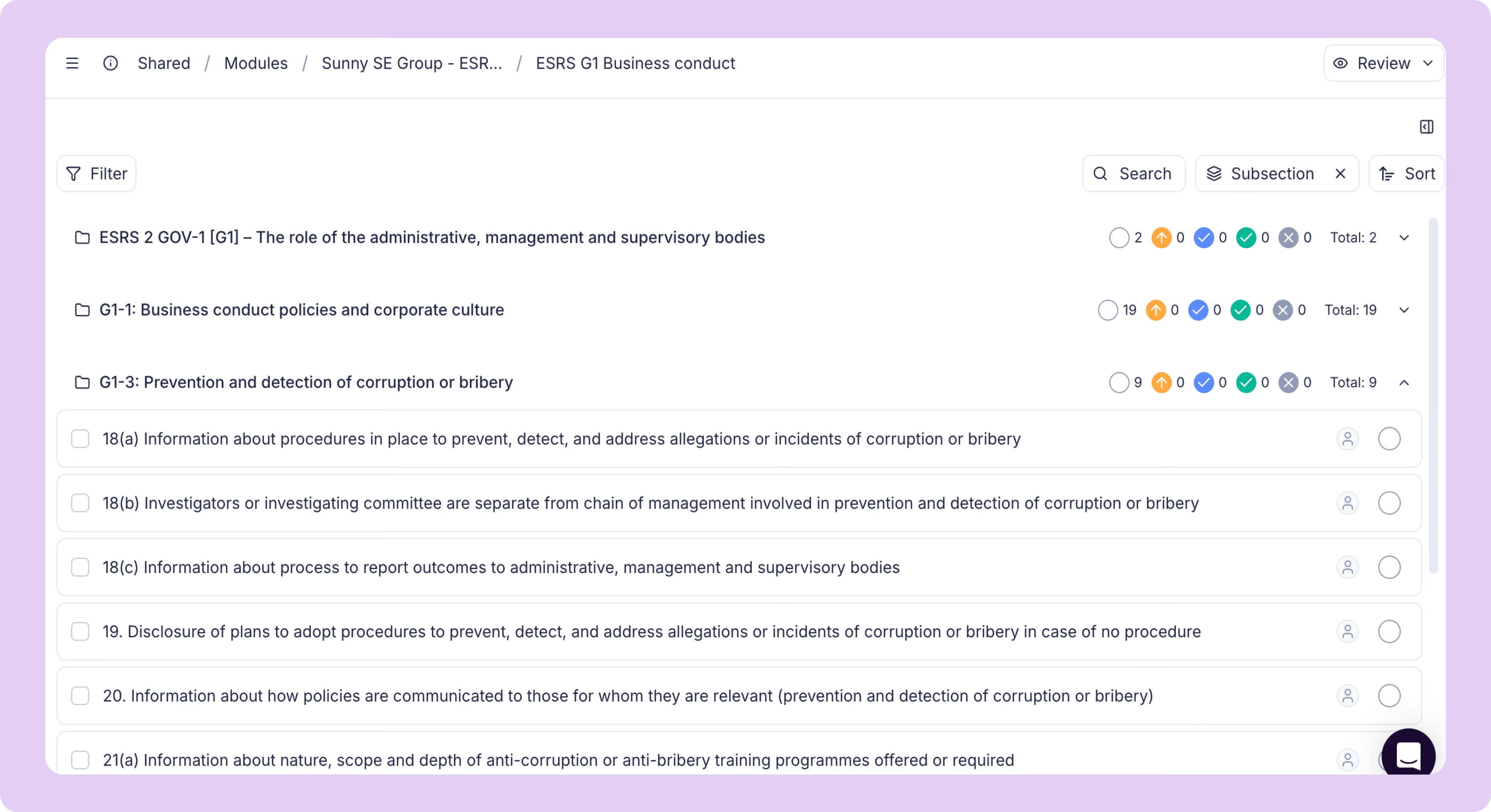
In the November 2025 EFRAG draft, G1 carries six Disclosure Requirements. Each is reported under the ESRS 2 reporting areas (governance, strategy, IRO management, metrics and targets), through the consolidated GDR-P/A/M/T pattern.
Sub-topics of ESRS G1
The sub-topics that feed the six Disclosure Requirements above are:
- Corporate culture
- Protection of whistleblowers
- Animal welfare
- Political engagement and lobbying activities
- Management of relationships with suppliers, including payment practices
- Corruption and bribery
- Prevention and detection, including training
- Incidents
Objectives of ESRS G1
The objective of ESRS G1 is to understand how the administrative, management and supervisory functions shape, monitor, promote and evaluate a company's culture. The Governance Standard focuses on the following business conduct matters:
- Business ethics and organisational culture, including the policies for anti-corruption and anti-bribery, the protection of whistleblowers, and animal welfare
- Managing relationships with suppliers, including practices related to payment — especially late payment to small and medium-sized enterprises
- Activities and commitments related to political influence, including lobbying
Inform yourself further and gain valuable insights of the other ESRS:
It's Time to Prove
What You Already Do
Your next questionnaire, assessment, or audit meets traceable proof.
With Sunhat, you verify your evidence once, then reuse it everywhere.
See how you can get there.



Frequently Asked Questions
ESRS G1 is the only governance standard in the ESRS framework. It provides the disclosure requirements for companies to report on their organisational conduct — supplier relationship management, anti-corruption and anti-bribery, whistleblower protection, lobbying, animal welfare and supplier payment practices.
The objective is to increase the understanding of how a company's administrative, management and supervisory functions shape, monitor, promote and evaluate its corporate culture — and how the company manages the risks and opportunities tied to business conduct.
ESRS G1 focuses on Business Conduct. It carries six Disclosure Requirements (G1-1..G1-6) in the November 2025 EFRAG draft: G1-1 Business conduct policies and corporate culture; G1-2 Management of relationships with suppliers; G1-3 Prevention and detection of corruption and bribery; G1-4 Confirmed incidents of corruption or bribery; G1-5 Political influence and lobbying activities; G1-6 Payment practices.
ESRS G1 covers corporate culture, whistleblower protection, animal welfare, political engagement and lobbying activities, management of relationships with suppliers (including payment practices), and corruption and bribery (prevention, detection, training and incidents).
No. Unlike ESRS E4, S2, S3 and S4 — which Wave 1 reporters may omit in full for financial years prior to FY 2027 — ESRS G1 has no Wave 1 omission under ESRS 1 §125 in the November 2025 EFRAG draft. The standard applies in full to Wave 1 reporters from the start of their reporting cycle, subject to the materiality filter.
Omnibus I raised the mandatory CSRD scope to >EUR 450M turnover AND >1,000 employees; limited Wave 1 to FY 2024-2026; deleted Wave 2/3; introduced a statutory value-chain cap ("protected undertakings," ≤1,000 employees) capped at the VSME standard; suspended mandatory XBRL tagging; and mandated the Commission to revise the ESRS to remove least-important datapoints and prioritise quantitative over narrative. For G1 specifically, the internal-controls language has been narrowed and aligned with the materiality filter. The Commission adopted the revised delegated act on 3 July 2026; it applies from FY 2027 (voluntary early use from FY 2026).





%201.svg)