
Latest Update November 10, 2026:
[cg_add-class=heading-style-h4]In a Nutshell
- EU Taxonomy reporting follows CSRD scope. From financial year 2027, that means companies with more than 1,000 employees and more than EUR 450 million net turnover (Directive (EU) 2026/470).
- Since 1 January 2026, activities that together stay below 10% of turnover, CapEx or OpEx can be left unassessed, as long as they are reported separately as non-material.
- Companies can skip the OpEx KPI entirely when operational expenditure is not material to their business model, provided they disclose the total and explain why.
- The hard part has not changed: an aligned activity still has to pass its technical screening criteria, do no significant harm and meet minimum safeguards, with evidence an auditor can follow.
The EU Taxonomy rulebook changed twice within a year. Directive (EU) 2026/470 cut the number of companies that must report, and Delegated Regulation (EU) 2026/73 cut how much they must disclose. As of November 2026, one misreading keeps coming up in our conversations with sustainability teams: that the Omnibus made the EU Taxonomy optional. It made the Taxonomy narrower and lighter. Companies still in scope report fewer datapoints, but every activity they call aligned still needs proof behind it.
What the EU Taxonomy Is and What It Is Not
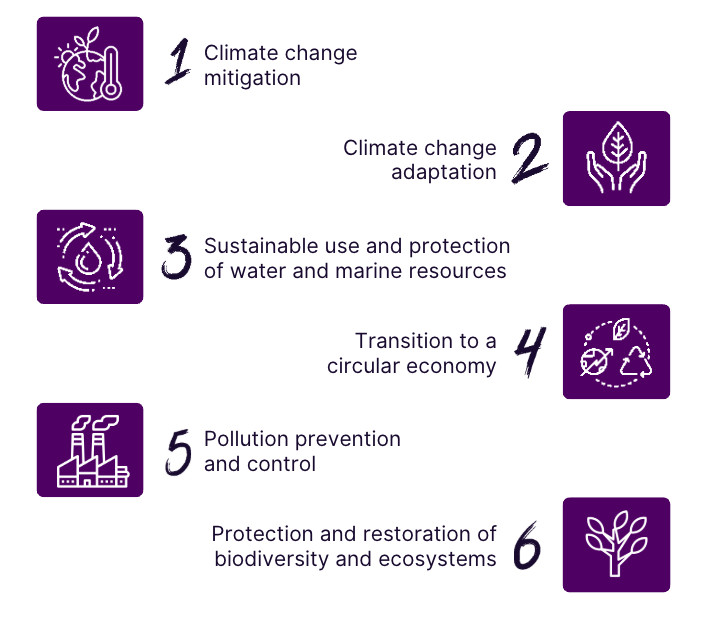
The EU Taxonomy is a classification system that defines which economic activities count as environmentally sustainable. It was established by Regulation (EU) 2020/852 to channel capital toward the climate and environmental transition, and it measures activities against six environmental objectives set out in Article 9:
- Climate change mitigation
- Climate change adaptation
- Sustainable use and protection of water and marine resources
- Transition to a circular economy
- Pollution prevention and control
- Protection and restoration of biodiversity and ecosystems
The Taxonomy is a disclosure and classification framework. It bans nothing, and an activity it does not cover is not automatically "unsustainable"; the EU simply has not defined criteria for it.
The regulation itself is short. The detail lives in delegated acts:
Who Must Report Under the EU Taxonomy from 2026
Article 8(1) of the Taxonomy Regulation applies to every company that must publish sustainability information under Articles 19a or 29a of the Accounting Directive. In practice, Taxonomy scope equals CSRD scope, so every change to the CSRD changes who reports under the Taxonomy.
Directive (EU) 2026/470, the final Omnibus text published on 26 February 2026, sets that scope. Sustainability reporting now applies to companies with more than 1,000 employees on average and a net turnover above EUR 450 million, measured at individual or group level. The new scope applies to financial years starting on or after 1 January 2027. Companies that reported in the first wave but fall below the new thresholds leave the regime from financial year 2027, and Member States may exempt them already for financial years 2025 and 2026. Member States must transpose the changes by 19 March 2027.
National transposition still decides the details. Germany has not yet transposed the CSRD. As of 10 November 2026, the bill is still in committee at the Bundestag. Until it passes, companies covered by the former Non-Financial Reporting Directive continue to publish a non-financial statement under sections 289b ff. of the German Commercial Code, and the Taxonomy disclosure duty stays attached to that statement.
Financial companies get a temporary opt-out. Until 31 December 2027, banks, insurers and asset managers can skip detailed Taxonomy KPIs if they publish a standard statement that they claim no Taxonomy-aligned activities. The Commission's FAQ notice C/2026/2558 makes clear this is all or nothing: a financial company that issues Taxonomy-aligned green bonds or claims aligned financing cannot use it.
Companies outside scope can still report voluntarily. Banks may include exposures to companies that report on a voluntary basis in their own KPIs (recital 11 of Delegated Regulation 2026/73). For a mid-sized company seeking green financing, voluntary Taxonomy data can still carry weight with lenders.
{{cta}}
What the 2026 Taxonomy Simplification Act Changed
Delegated Regulation (EU) 2026/73 applies from 1 January 2026 and is the biggest change to Taxonomy reporting since its launch. It amends the Disclosures Delegated Act and simplifies some DNSH criteria in the Climate and Environmental Delegated Acts. The technical screening criteria for substantial contribution stay unchanged.
When companies switch to the new rules, the comparative figures from the prior year were calculated under the old method. The FAQ notice asks companies to explain this in the contextual information and allows them to show recalculated prior-year KPIs.
How the 10% Threshold Works in Practice
The threshold applies to whole activities, never to parts of them. The Commission's FAQ uses the example of a construction company active in six countries. Excluding one country's non-aligned construction work, worth 6.7% of turnover, would raise its reported alignment ratio from 83.3% to 100%. That is exactly the distortion the rules forbid: a material activity must be assessed in its entirety.
Three further rules shape how far the threshold goes:
- Consistency with financial reporting. If an activity forms a reportable segment under IFRS 8, it is material for financial reporting and should not be treated as non-material for the Taxonomy (FAQ 7).
- Geography can qualify. Activities in a country below the 10% line can be left out, provided that choice is consistent with segment reporting and does not split a material activity (FAQ 9).
- Name the sectors. For non-material activities, companies disclose which sectors they belong to and why they are not material. NACE codes are recommended, not mandatory (FAQ 10).
In practice, the threshold adds a calculation step before any screening starts. Many teams still run that calculation in spreadsheets, activity by activity, to decide what needs screening at all. Document it, because it is the first thing an assurance provider will ask about.
Eligible vs. Aligned: The Three-Part Test
An activity is Taxonomy-eligible if a delegated act describes it. It is Taxonomy-aligned only if it meets all conditions of Article 3 of the Taxonomy Regulation:
- Substantial contribution. The activity meets the technical screening criteria for at least one of the six objectives.
- Do no significant harm (DNSH). It does not significantly harm any of the other five objectives (Article 17), as defined by the DNSH criteria in the delegated acts.
- Minimum safeguards. The company carrying out the activity has procedures in line with the OECD Guidelines for Multinational Enterprises and the UN Guiding Principles on Business and Human Rights (Article 18).
Minimum safeguards and ESRS social and governance data. Disclosures under ESRS S1 and G1 on human rights incidents and corruption fines are evidence for the minimum safeguards test, and you already collect much of this data for your sustainability statement. Deloitte's review of 2024 ESRS reports in Central Europe found that among companies treating these topics as material, 3.2% disclosed human-rights-related fines and 0.8% disclosed corruption or bribery fines. Deloitte notes that such fines can indicate non-compliance with minimum safeguards, which would rule out alignment.
DNSH and supplier chemical data. The pollution DNSH criteria require information on hazardous substances, which links Taxonomy reporting to REACH and supplier data. The 2026 simplification removed the requirement to screen articles for certain hazardous substances precisely because suppliers have no legal duty to pass that information on.
"The criteria are disconnected from reality." We hear this objection often, usually about very specific technical criteria that seem far removed from how a business runs. It is partly fair: the Commission itself has announced a review of the technical screening criteria. Until that review becomes law, the criteria apply as written, and an activity that fails one criterion cannot be reported as aligned.
How to Report the EU Taxonomy in Five Steps
Step 1: Confirm Scope and Rule Set
Check whether your company falls under Article 8 under the CSRD as transposed in your Member State. Then decide which rule set applies: for financial year 2025 you can choose old or new rules, from financial year 2026 the amended Disclosures Delegated Act applies. Record the decision, because the report must state it.
Step 2: Map Activities and Apply the 10% Filter
List your economic activities and match them to the activity descriptions in the delegated acts. Then calculate which eligible activities fall below the 10% threshold for each KPI. One common obstacle: financial data often exists only at legal-entity level, while the Taxonomy assesses activities. Companies with mixed business lines need an allocation key before any ratio is meaningful.
Step 3: Screen Criteria and Collect Evidence
For every material eligible activity, check the technical screening criteria, the DNSH criteria and the minimum safeguards. This is where most of the effort sits, not in the ratio calculation. Tag evidence to the KPI it supports: a CapEx claim can rest on a CapEx plan for future alignment, while a turnover claim must be true today. Keeping that distinction visible turns a ratio into defensible proof.
Step 4: Calculate the KPIs with Finance
Turnover, CapEx and OpEx KPIs are financial figures, but in many companies the reporting work lands on the sustainability team. Getting reconciled numbers from Finance often takes more than a routine request. Svea Scherleithner, former Head of Sustainability at Heraeus Precious Metals, named the underlying principle on our Talking Proof podcast. "Ich würde Nachhaltigkeitsdaten gar nicht so stark von Finanzdaten trennen," she said: she would not separate sustainability data that strongly from financial data. For the Taxonomy, that means one data basis, one owner who signs off each figure, and a reconciliation to the financial statements.
Step 5: Disclose in the Sustainability Statement
Taxonomy disclosures belong in the sustainability statement of the management report. Under the revised ESRS adopted by Delegated Regulation (EU) 2026/1563, companies may present them in a separate appendix within the management report (ESRS 1, paragraph 106). The revised ESRS apply to financial years starting on or after 1 January 2027, and companies can use this presentation option already for financial year 2026. Digital tagging of sustainability information is not required until the Commission adopts the tagging rules. The auditor's limited assurance opinion covers compliance with Article 8.
Success Factors and Best Practices for Implementing the EU Taxonomy
Clear governance. Define responsibilities and escalation paths across Sustainability, Finance and the business units, including who reviews each assessment and who signs off. Document decisions and assumptions carefully, including which rule set you applied and which activities you treated as non-material and why. That documentation is what makes the report auditable.
Training. Everyone involved needs to understand the basics of the EU Taxonomy and how the requirements apply in their area. Include Finance and Controlling explicitly, since they own the numbers behind every KPI. Training materials and regular workshops keep knowledge current as the rules change.
Data availability. Data remains one of the biggest challenges. Accurate, continuous collection at activity level is what allows you to demonstrate alignment, not a once-a-year scramble before the report deadline. Sustainability and financial data should sit on one shared basis.
The right tools. A Proof Software helps you bring all relevant data together in one place, from financial figures and environmental targets to the specific EU Taxonomy criteria. With Sunhat, you benefit from:
- Flexibility and scalability: Sunhat adapts to changing EU Taxonomy requirements and grows with your business.
- Seamless integration: Sunhat connects to your existing finance systems, so your figures rest on one consistent database.
- High data quality: Sunhat supports regular quality checks so your data meets the standard assurance requires.
- Audit trail and documentation: Sunhat documents every change and assessment, so you can show how each figure was produced.
What Is Still Moving in 2026 and 2027
Companies that document their screening decisions criterion by criterion can rerun them when the criteria change, because their records show exactly why each activity passed. Companies that only keep the final ratios will start from scratch.
- Technical screening criteria review. The Commission consulted on draft amendments to the Climate and Environmental Delegated Acts from 17 March to 14 April 2026. As of November 2026, they are not adopted. The Commission aims to adopt them in the fourth quarter of 2026, with application planned from 2027 reporting periods.
- Disclosures Delegated Act review. ESMA delivered technical advice on selected KPIs, including the OpEx KPI, on 29 October 2026. The Commission plans a further revision of the disclosure rules based on that advice.
- Bank KPIs. The Trading Book and Fees and Commissions KPIs for credit institutions are deferred to 1 January 2028.
The EU Taxonomy no longer applies to everyone, but for those still in scope, the standard of proof has not dropped. Fewer datapoints mean each one carries more weight in assurance. Book a meeting to see how Sunhat turns EU Taxonomy screening into proof your auditor can follow.
It's Time to Prove
What You Already Do
Your next questionnaire, assessment, or audit meets traceable proof.
With Sunhat, you verify your evidence once, then reuse it everywhere.
See how you can get there.



Frequently Asked Questions
Only if it falls under the CSRD. From financial year 2027, that means more than 1,000 employees and more than EUR 450 million net turnover under Directive (EU) 2026/470. First-wave reporters below these thresholds remain in scope for 2025 and 2026 unless their Member State exempts them.
Yes, if operational expenditure is not material for your business model. You still disclose total OpEx and explain why it is not material. If OpEx is material, you assess it, but can leave out activities that together stay below 10% of total OpEx.
No. The threshold applies to whole activities. Excluding the non-aligned part of a material activity distorts the KPIs and contradicts the rules set out in the Commission's FAQ notice.
You can choose between the rules as amended by Delegated Regulation 2026/73 and the rules in force until 31 December 2025. Whichever you choose, apply it in full and state your choice in the report.
It can pay off if lenders or investors ask for Taxonomy data or if you seek green financing. Voluntary reports still need the same rigor: an alignment claim without evidence weakens your position rather than strengthening it.


Step by Step: Your CSRD Roadmap 2026 Post-Omnibus
Includes checklists, a project timeline, and the data points that cause the most trouble in practice. Drafted from the firsthand experience of Sunhat sustainability experts who run CSRD reports themselves