
Latest Update April 22, 2026:
[cg_add-class=heading-style-h4]In a Nutshell
- PPWR is a directly applicable EU regulation, o national transposition, no grace periods. From August 12, 2026, non-compliant packaging cannot legally enter the EU market.
- The primary cost of non-compliance is not fines but lost market access: delayed product launches, pulled SKUs, and unfulfillable distributor contracts.
- Liability flows through the entire value chain. Brand owners and importers carry exposure for their suppliers’ non-compliance. Supplier contracts must include PPWR compliance clauses, audit rights, and clear remedies.
- The most common compliance failures stem from supplier data gaps, not deliberate non-compliance. Every missing test report or certificate is a potential market access risk.
- Companies that start supplier conversations early, assign cross-functional ownership, and build scalable proof systems now will arrive at the deadline protected.
A directive requires each EU member state to transpose requirements into national law, creating variation and, historically, some degree of flexibility in enforcement timing. A regulation applies directly and uniformly across all 27 member states from the date it becomes enforceable. There is no national grace period. There is no transitional window for new products placed on the market after August 12, 2026. If your packaging does not comply on that date, it cannot legally enter the EU market.
This is not a future risk to manage. It is a present exposure to close.
What Non-Compliance Actually Means in Practice
When most companies hear "PPWR non-compliance," they think about fines. Fines are part of the picture, but member states have until February 2027 to set their specific penalty frameworks, and the exact amounts remain unclear in most countries. What is already in force is more immediate.
The primary enforcement mechanism under PPWR is market access. Non-compliant packaging cannot be placed on the EU market. For a manufacturer or brand owner, that means product launches are delayed, existing SKUs pulled from shelves, and contracts with EU distributors and retailers that cannot be fulfilled. The commercial cost of a product being blocked from a market is almost always larger than any regulatory penalty.
The cost math gets sharper when you look at the substance compliance side. A single PFAS analysis for one packaging type costs from a several hundreds euro up to the region of €17,000. For food-contact packaging, that test is not optional. It is the proof that stands between your product and the market. A company that waits until Q2 2026 to commission substance screening faces two problems simultaneously: the financial pressure of running multiple high-cost tests in a short window, and the lead time risk of getting results back after the deadline has passed. Laboratory backlogs are already building as more companies reach the same realization at the same time.
From August 2026, every packaging type requires a signed EU Declaration of Conformity, a complete Technical Documentation file, and EPR registration in each relevant member state. If your packaging is found to lack any of these during a market surveillance check, the authority can require it to be withdrawn. If your packaging contains PFAS above the regulatory threshold in food-contact applications, the restriction applies immediately.
There is also no general grace period for existing stock once the enforcement date passes. Some member states may allow pre-deadline inventory to be sold through, but rules vary by country and are not guaranteed. Planning on a stock clearance window is not a compliance strategy.
Liability Moves through the Supply Chain
This is the piece that procurement and legal teams need to understand clearly.
PPWR liability does not sit only with the manufacturer. Risk flows through the entire value chain: from manufacturer to brand owner to distributor to the end customer. If you are a brand owner sourcing from a contract manufacturer whose packaging is found to be non-compliant, you carry exposure. If you are a distributor selling products from a supplier who has not completed EPR registration in your member state, you are at risk.
This has direct implications for commercial agreements. Packaging compliance needs to be embedded in your supplier contracts now, before enforcement begins and before a non-compliance event creates a liability dispute with your supply chain partner.
Specifically, your supplier agreements should include mandatory compliance clauses requiring PPWR-compliant packaging and complete documentation. They should define who bears the cost of packaging redesign if recyclability or minimization requirements are not met. They should grant you audit rights to verify documentation and test results. And they should establish clear remedies if a supplier's non-compliance causes your product to be withdrawn from a market.
These are not hypothetical provisions but the contractual protections that determine who absorbs the cost when something goes wrong.
The Proof Gap Is a Supply Chain Problem
The most common source of PPWR non-compliance we see is not a deliberate decision to ignore the regulation. It is a data gap.
A manufacturer cannot sign a Declaration of Conformity without substance test results from their material supplier. A brand owner cannot complete EPR registration without accurate packaging weight and composition data from their contract manufacturer. A company cannot demonstrate recycled content compliance without third-party certificates of origin from their supplier.
Every proof gap in your supply chain is a potential compliance exposure. And the longer you wait to identify and close those gaps, the more constrained your options become. Suppliers have their own lead times for testing, certification, and documentation. If you start requesting PFAS test reports in July 2026, you will not have them in time.
How to Protect Yourself before August 2026
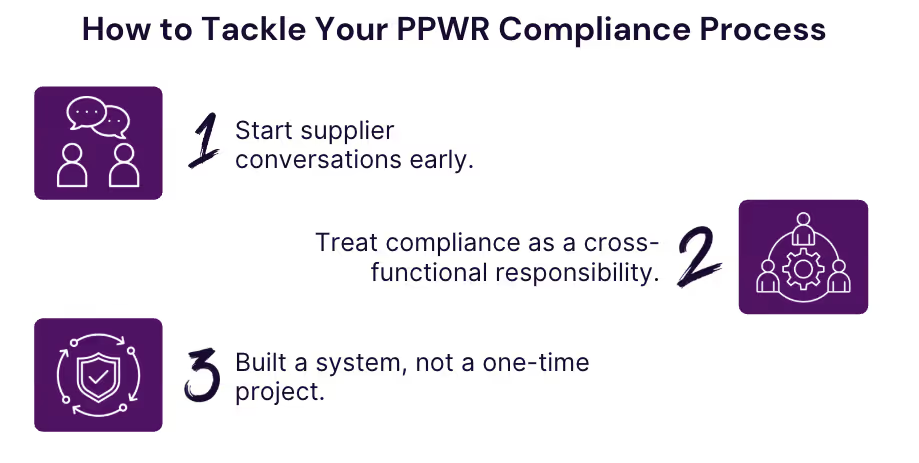
The companies that arrive at August 2026 with the least exposure share three things in common.
They started supplier conversations early. The data you need for PPWR compliance comes from your packaging suppliers, your material suppliers, and in some cases your recyclers. Getting that data takes time, follow-up, and in some cases contract amendments to make disclosure mandatory. Start now, not when the deadline is visible on the calendar.
They treated compliance as a cross-functional responsibility. PPWR touches procurement (supplier data and contracts), sustainability (recyclability and CSRD alignment), regulatory (EPR registration and documentation), and legal (contract clauses and liability). Organizations that assign it to one team and treat it as a side project will consistently find proof gaps that a coordinated effort would have caught early.
They built a system, not a one-time project. PPWR is not a 2026 deadline followed by business as usual. Requirements continue phasing in through 2028, 2029, 2030, and beyond. The organizations that close their proof gap by August 2026 and then build the infrastructure to stay compliant through the next decade are the ones that turn compliance into a competitive advantage rather than a recurring crisis.
Collaborative Proof Is How You Protect Yourself
Sunhat is the Collaborative Proof Platform built for exactly this challenge. We help manufacturers, brand owners, and importers manager their data at scale. Our Proof AI agents automate data management that currently costs your team weeks. Our compliance experts know what documentation market surveillance authorities look for, what supplier contracts need to say, and what proof gaps are the highest priority to close right now.
You already do the work. Sunhat helps you prove it, before a regulator, a customer, or an audit asks you to.
It's Time to Prove
What You Already Do
Your next questionnaire, assessment, or audit meets traceable proof.
With Sunhat, you verify your evidence once, then reuse it everywhere.
See how you can get there.


.avif)
Frequently Asked Questions
Member States have until February 2027 to establish their specific penalty frameworks. The more immediate risk, however, concerns market access: non-compliant packaging may not be placed on the EU market. This means halted product launches and withdrawn SKUs.
There is no EU-wide transition period. Some Member States may allow clearance sales for goods produced before the deadline, but the rules vary by country. Planning on such a window is risky and not a robust compliance strategy.
Under the PPWR, the company placing the product on the EU market is liable. If you are a brand owner or importer, the legal responsibility lies with you, regardless of what your supplier has assured you. Therefore, compliance clauses and audit rights must be included in your supplier contracts.
A single PFAS analysis can cost from several hundreds up to 17,000 euros. For companies with large packaging portfolios, a risk-based approach is recommended, starting with food contact packaging and prioritizing from there.
No. A supplier’s declaration alone does not meet the requirements of the PPWR. You need specific, structured, and third-party-verified data: test reports, certificates of analysis, and traceable documentation for each type of packaging.

Everything You Need for PPWR Compliance Now
Free Toolkit: What to collect, how to prioritize, and where most companies get stuck.




%201.svg)