Latest Update April 22, 2026:
[cg_add-class=heading-style-h4]In a Nutshell
- PPWR applies to companies with more than 10 employees and revenue above €2 million that place packaged products on the EU market—regardless of where they manufacture.
- Your role (manufacturer, importer, distributor, or brand owner) determines your exact obligations. If your name or trademark is on the packaging, you are legally the manufacturer and own both design compliance and EPR obligations.
- From August 12, 2026, four things must be in place for every packaging type: a signed EU Declaration of Conformity, a complete Technical Documentation file, EPR registration in each relevant member state, and substance compliance proof.
- Non-EU manufacturers selling into the EU carry the same obligations as EU-based producers. There is no import exemption.
- Start now: run a packaging audit, get substance data from suppliers, map your EPR registration status across all member states, and assign cross-functional ownership.
When one of Germany's largest retailers sat down with a compliance consultant earlier this year, they came expecting a briefing on labeling requirements. What they got instead was the news that they are legally the manufacturer for every product that carries their store brand. Every Declaration of Conformity. Every Technical Documentation file. Every EPR registration, in every country where that product is sold.
They had not known. And they are not alone.
The Packaging and Packaging Waste Regulation (PPWR) entered into force on February 11, 2025. The first major enforcement deadline is August 12, 2026. That is less than five months away. And in almost every conversation our experts have with manufacturers, brand owners, and importers right now, the starting point is not "what do we need to do." It is "does this actually apply to us?"
It does. The question is how, and what you are responsible for proving.
This article walks you through the scope check, the role distinction that many companies get wrong, and the actions that matter most in your first 90 days.
Who Counts as an Obligated Producer?
PPWR defines obligated producers as companies placing packaged products on the EU market with more than 10 employees and revenue above €2 million. That covers the vast majority of manufacturers and brand owners operating at any meaningful scale in Europe.
But scope is not just about your size. It is about your position in the supply chain.
If your product sits in packaging when it reaches an EU customer, you are likely obligated, regardless of where you manufacture, where your packaging is produced, or whether you use a third-party logistics provider. The regulation follows the product to market, not the production site.
Two edge cases catch companies out regularly:
- First, group structures: if your subsidiary or affiliate places products on the market, that entity is the obligated producer, even if the parent company manages compliance centrally.
- Second, non-EU producers: if you manufacture outside the EU and sell into it, you carry the same obligations as an EU-based manufacturer. There is no import exemption. The PPWR’s mirror clause requires imported packaging to meet the same recycled content and environmental standards as EU-made goods, and you need audited proof from your resin suppliers and converters to demonstrate it.
Your Role Determines Your Obligations
This is where most companies lose significant time. PPWR assigns different responsibilities depending on whether you are a manufacturer, importer, distributor, or brand owner. These roles are not interchangeable, and they are not always obvious.
Manufacturers carry the design and conformity responsibility. You own the technical documentation file for each packaging type, and you sign the EU Declaration of Conformity. If your packaging does not meet recyclability, substance, or minimization requirements, you are the first point of accountability.
Importers verify supplier compliance and documentation for goods coming from outside the EU. You cannot simply pass along what your supplier gives you; you are legally responsible for confirming that the packaging meets PPWR requirements and that the technical documentation is complete and available before you place the product on the market. If the EU authorities come knocking, they don't call the factory in Vietnam; they call the Importer in Rotterdam.
Distributors confirm that compliant products are what they are selling. You carry a check responsibility, not a documentation responsibility, but if you knowingly sell non-compliant packaging you are exposed. You must verify that the packaging is correctly labeled, ensuring it features the required QR codes for material identification and, where applicable, the CE mark.
Producers (including Brand Owners) are responsible for Extended Producer Responsibility (EPR) registration in each EU member state where their products are sold. If you put your name or trademark on the packaging, even if it's commissioned from a contract manufacturer, you are legally considered the manufacturer. This means you own both the design compliance and the financial EPR obligations (the green fees) in every market where that product appears.
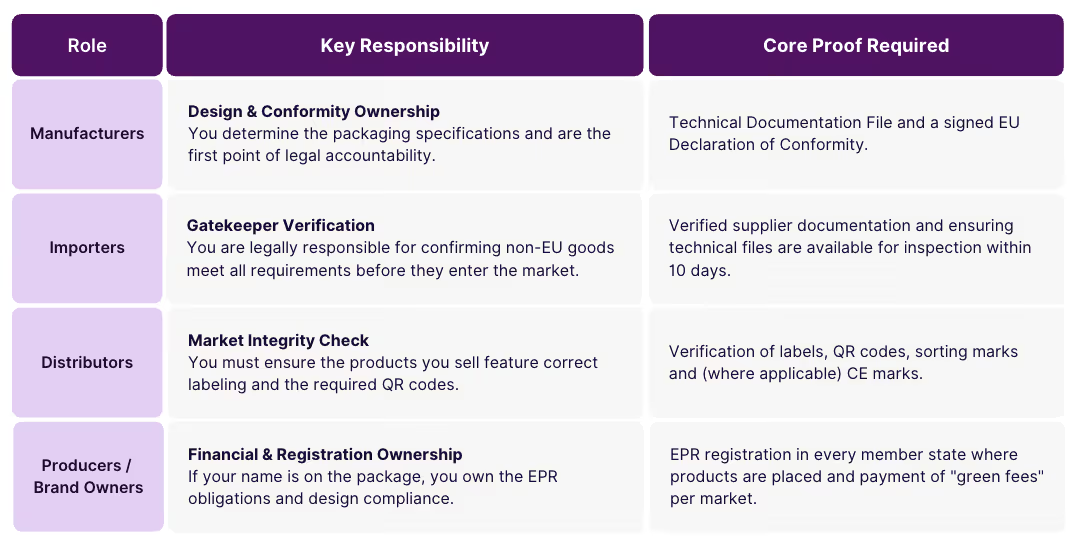
Liability under the PPWR always moves toward the party placing the product on the EU market.
- The Chain of Command: EU authorities do not contact factories outside the EU; they hold the Importer or the Manufacturer/Brand Owner accountable.
- The Brand Risk: Because putting your trademark on a product makes you the "Manufacturer" by law, you cannot contract away this responsibility. If your supplier fails to provide substance test results or recyclability data, the legal exposure sits entirely with you.
Getting your role wrong means misallocating compliance resources and leaving gaps that an auditor or market surveillance authority will find.
What Being Obligated Actually Requires
From August 12, 2026, four things must be in place for every packaging type you place on the EU market.
- An EU Declaration of Conformity: a signed legal document for each packaging type. A supplier statement does not substitute for it. You sign it, and you are accountable for its accuracy.
- A Technical Documentation file: the full material breakdown for each packaging type, including substance test results for PFAS and heavy metals in food-contact applications, recycled content documentation, design specifications covering coatings, inks, and adhesives, and a written explanation of why the packaging cannot be further minimized without compromising product safety or functionality. Keep this for five years for single-use packaging and ten years for reusable.
- EPR registration in every member state where you sell. Each national registry has its own requirements, timelines, and reporting formats. There is no single EU-wide registration. If you sell in 27 countries, you have 27 registrations to manage.
- Substance compliance: PFAS restrictions for food-contact packaging apply from August 12, 2026. Without proof of compliance by that date, your product is legally unmarketable.
Your First 90 Days
This is not a list of eventual actions. These are the things that move you from exposed to protected before enforcement begins.
Run a packaging audit.
Categorize every SKU against PPWR packaging categories. Identify which materials, formats, and markets are involved. Do not limit this to primary packaging. Secondary display packaging and tertiary transport packaging are also in scope. This gives you a clear picture of your proof gap: the distance between where your documentation stands today and where it needs to be.
Get substance data from your suppliers now.
Request formal technical declarations for PFAS and heavy metal content. Self-declarations are not enough. Ask for test reports. For food-contact materials, this is the highest priority conversation you have this month.
Map your EPR registration status.
List every EU member state where your products are sold and confirm whether you are registered, in process, or not yet started in each. Registration timelines vary by country, and several national registries are currently running significant backlogs as thousands of companies rush to comply at the same time.
Assign internal ownership.
PPWR touches procurement, regulatory, sustainability, and legal. Someone needs to own the cross-functional coordination, and that person needs a collaborative system to work in, not a spreadsheet.
You Already Do the Work. Sunhat Helps You Prove It.
Most of the data PPWR requires already exists somewhere in your organization or your supplier relationships. The challenge is collecting it, structuring it, and keeping it audit-ready across every SKU and every market.
Sunhat's Collaborative Proof Platform is built for exactly this. Our Proof AI agents help you manage supplier data at scale, structure your Technical Documentation files, and keep your Declarations of Conformity current. Our compliance & sustainability experts work alongside your team to make sure nothing is missed and every proof gap is closed before a deadline becomes a crisis.
If you are not sure where your organization stands today, that is the right place to start. Book a scope assessment with our team and find out exactly what you are obligated to prove, and how far you are from proving it.
It's Time to Prove
What You Already Do
Your next questionnaire, assessment, or audit meets traceable proof.
With Sunhat, you verify your evidence once, then reuse it everywhere.
See how you can get there.


.avif)
Frequently Asked Questions
No. The PPWR applies only to companies with more than ten employees and a turnover exceeding two million euros. Smaller suppliers may be affected through business relationships with larger customers.
Yes. If you manufacture outside the EU and sell to the EU, you are subject to the same requirements as EU manufacturers. You must demonstrate that your packaging meets the same standards.
You can hire a service provider, but your company remains legally responsible. The service provider can reduce the administrative workload, but not your liability.
Non-compliance can lead to market surveillance measures, product recalls, and fines. EU member states can remove products from the market if they lack proof of compliance.

Everything You Need for PPWR Compliance Now
Free Toolkit: What to collect, how to prioritize, and where most companies get stuck.




%201.svg)