


Key Takeaways
Latest Update October 14, 2026:
- EcoVadis scores four themes across 21 criteria, and every answer needs a supporting document. There is no credit for a true but unevidenced claim.
- Medals have been percentile-based since 2024. EcoVadis does not publish the cutoff scores, and last year's threshold is not a safe assumption for this year.
- A theme score below 30 disqualifies a company from any medal, regardless of its overall score.
- A scorecard is valid for 12 months. Reassessment is not automatic: a new sharing request more than 12 months after the last assessment triggers it, and annual reassessment is EcoVadis's own recommended practice.
What Is EcoVadis, and What Does a Rating Mean for Your Company?
EcoVadis rates how a company manages sustainability across four themes: Environment, Labor and Human Rights, Ethics, and Sustainable Procurement. More than 100,000 companies now hold a scorecard, and for a growing share of enterprise buyers, that scorecard has become a condition of doing business rather than a nice-to-have credential.
A rating covers one specific scope, and getting that scope wrong is the most expensive mistake a company can make in the process. EcoVadis assesses at three levels: a Group assessment, which covers a legal entity and its subsidiaries down to any joint venture where you hold at least 50%; an Entity assessment, for a single legal entity with no subsidiaries beneath it; and a Site assessment, for one facility with no legal entity name of its own. A Group score cannot be applied to a subsidiary a customer asks about by name. If that happens, the subsidiary needs its own assessment.
For a customer, supplier, or investor asking for your EcoVadis scorecard, the rating is a fast, standardized way to check sustainability performance without running their own audit. For the company being assessed, it is 30 business days of work up front and a scorecard that then governs how that company gets talked about in due diligence for the next 12 months.
That is why the score is commercially load-bearing rather than a compliance exercise on the side. A procurement team screening suppliers, an investor running due diligence, or a customer qualifying vendors for an RFP increasingly treats an EcoVadis scorecard as a gate rather than a data point: below a certain threshold, or without a required medal at all, a deal can stall regardless of how strong the underlying relationship is. The work of building the rating and the work of protecting revenue are, in practice, the same work.
How Does EcoVadis Scoring Actually Work?
EcoVadis organizes its questionnaire in a hierarchy, and understanding that hierarchy is the fastest way to understand your own scorecard. At the top sit four themes: Environment, Labor and Human Rights, Ethics, and Sustainable Procurement. Beneath those sit seven management indicators: Policies, Endorsements, Measures, Certifications, Coverage (for large companies only), Reporting, and 360° Watch. Beneath the indicators sit the 21 criteria that actually generate your score, and beneath those, the individual questions and their answer options.
Three pillars run underneath the whole structure regardless of theme: Policies, Actions, and Results. A policy states an intention. An action shows the intention was carried out. A result shows the action worked. EcoVadis wants evidence across all three, not concentrated in one, which is why a company with an excellent policy library and no KPI reporting still scores unevenly.
Not every one of the 21 criteria applies to every company. Your specific set of activated criteria depends on three inputs decided at registration: your company size, your industry classification under the ISIC system, and whether you operate in countries EcoVadis flags as carrying particular risks. Industry classification follows a rule that surprises most first-time raters: where a company's scope spans several activities, EcoVadis assigns the industry that represents the highest sustainability impact, not the one generating the most revenue.
Not every indicator carries equal weight. EcoVadis states directly that the Environment and Labor and Human Rights themes have the greatest impact on the overall score, alongside the Policies and Measures indicators specifically. One of the seven indicators, Coverage, only applies to large companies, and checks whether policies and actions extend consistently across every site and subsidiary in scope rather than only the headquarters.

What Are EcoVadis Medals, and How Are the Thresholds Set?
Since 2024, EcoVadis has awarded medals on percentile rank rather than fixed scores, and it does not publish the cutoffs, because they move every year with the rated population. Two conditions override the percentile ranking regardless of overall score: a theme score below 30 in any of the four themes disqualifies a company from any medal, and certain industries, including controversial weapons, tobacco, and companies drawing more than 20% of revenue from coal or unconventional oil and gas, are excluded from recognition outright.
Assuming last year's threshold still applies is one of the more common ways companies misjudge their own position. That comparison also runs wider than most companies assume: EcoVadis measures a company against every company it has assessed in the previous 12 months, across all industries worldwide, not against a company's own sector. A company in a demanding, high-scoring sector is held to the same bar as one in a sector where sustainability practices are less mature.
What we hear from our customers: In recent conversations, at least a dozen companies described losing a medal or missing one narrowly without having done anything worse than the year before. One manufacturer scored 85 points and received Gold, but told us the same score would have been Platinum a few months earlier. Another held a higher medal in 2022 at a lower score than it has today, and has since dropped a tier despite improving.
The EcoVadis Sustainability Ratings Index, 10th Edition, gives a clear sense of how fast the field is moving: the share of companies reaching Advanced+ status, a score of 65 or above, jumped from 19% in 2024 to 29% in 2025, the largest single-year gain the Index has recorded in ten years. A static score against a population moving that quickly is a real decline in relative standing, even if the number on the scorecard has not changed.
EcoVadis is explicit that a rating "reflects the information available at the time of assessment," is "not a guarantee of a company's future sustainability performance," and "should be interpreted alongside other sources of company information." That caveat is worth keeping in view alongside any benchmark figure, including the ones above.
Medals are not the only recognition worth tracking. A Committed badge and a Fast Mover badge exist for companies below the medal range, and both matter for a different reason than the medals do: a Committed badge signals a credible baseline to a customer running due diligence on a newer supplier, while a Fast Mover badge rewards a company that improved quickly rather than one that started high. For a company early in the process, targeting one of these two badges first, rather than a medal outright, is often the more realistic near-term goal.
The full theme-by-theme, company-size, and geography breakdown from the Ratings Index, the exact data behind "where you stand" for a company your size, sits in the Project Guide's benchmark section.
What Documents and Evidence Does EcoVadis Actually Require?
EcoVadis states its own rule in one sentence: the questionnaire "can only be answered by attaching documents to the options you selected." Selecting an answer without an attached document does not earn the point. This is the single fact that separates an EcoVadis assessment from a self-reported survey, and it is worth repeating because it changes how a team should prepare from day one: the job is not answering questions, it is matching evidence to options.
Not every document counts, and the same document type can pass or fail depending on how it was produced. A sustainability report or an ISO certificate typically counts. A slide deck or brochure written specifically to answer the questionnaire typically gets rejected, along with anything the analyst cannot read: EcoVadis runs automated text extraction on every upload, so a scanned image, a screenshot, or a locked file fails before a human ever reviews it. A policy needs a name, a date, and an approver attached; a quantitative target inside it also needs a baseline year, and from 14 October 2026 a target without one is rejected and does not count toward the Policy indicator. A KPI figure needs a stated unit and a reporting period. None of that is a matter of interpretation; it is closer to a technical specification.
What we hear from our customers: Multiple companies we've talked to described losing points on formalities rather than substance. Some reported evidence rejected because the company logo, company name or the assessed entity’s name was missing from the document header. Others lost points on an outdated document, or on evidence attached to the wrong question.
The fix is procedural, not creative: build the evidence library before opening the questionnaire, not while it is open.
Evidence also has a shelf life. A policy or an action stays valid for eight years before EcoVadis expects it refreshed, and KPI reporting expires after two years, since a labor or emissions figure from several years ago says little about the current state of a company. Treating evidence as something to file once and forget is how a company that scored well on its first assessment finds several of its own answers unsupported by the time reassessment comes around, not because the underlying practice lapsed, but because the paperwork proving it did.
The full document-by-document acceptance criteria, the 55-document allocation mechanics, and the exact validity windows for policies and KPI data live in the Project Guide. What matters here is the principle: EcoVadis assesses documented evidence, not intentions.
How Do You Improve Your EcoVadis Rating?
Most of the points a company loses in an EcoVadis assessment were, at some point, genuinely earned in practice. They disappear in a small number of predictable, avoidable mistakes, not a lack of real sustainability work. Improving your rating starts with eliminating these nine, before anything else:
- Avoid answering from memory instead of from paper. An undocumented answer scores the same whether it's true or not, because the analyst only ever sees the document, never the underlying fact.
- Avoid choosing "do not know" as a catch-all. Unlike "other" or "no specific mechanism in place," this option does not open a comment box, so it tells the analyst nothing about your actual situation.
- Avoid uploading a scanned document or a screenshot. EcoVadis runs automated text extraction, and a file it cannot read may not be fully considered even if a human would recognize it instantly.
- Avoid merging files to stay under the 55-document limit. This is prohibited outside a small number of permitted combinations, and a merged file that does not qualify gets rejected outright.
- Avoid deleting an older document to make room. Once it is gone, the analyst can no longer assess any option it supported, and those options drop out of the score entirely.
- Avoid missing the 30 September cutoff. Questionnaires submitted after this date typically do not publish before the end of the same calendar year, so this is less a single mistake than the compounding effect of several smaller delays.
- Avoid registering directly instead of through a customer's invitation link. This breaks the automatic connection between the finished scorecard and the partner who requested it.
- Avoid registering the wrong legal entity. The fix is a second, separately paid assessment rather than an edit, since a Group score cannot substitute for a subsidiary's own assessment.
- Avoid assuming an industry classification is negotiable on request. A company can contest it with ISO certificates or business registration documents, but EcoVadis states plainly that it cannot guarantee the requested industry will be applied.
What Is 360° Watch, and How Can It Affect Your Score?
360° Watch is the one EcoVadis indicator a company cannot answer directly. It draws on public information collected from more than 100,000 sources, including media, governments, trade unions, NGOs, and business networks. A company's own press releases are excluded. Findings typically cover the past five years, extending to seven or ten years for certain Ethics topics.
Each negative finding is classified minor, major, or severe, and each deducts points from the affected theme score. Findings also accumulate: several minor findings compound into the weight of a more serious one. Positive coverage with no adverse findings adds points back. Because 360° Watch findings can independently disqualify a company from a medal regardless of its overall score, it is worth checking on its own each cycle rather than only when a scorecard arrives lower than expected.
Reviewing 360° Watch findings on a schedule, rather than reactively, gives a company time to respond publicly or address the underlying issue before the next assessment, instead of learning about a severe finding for the first time from a lost medal.
How Do You Read Your EcoVadis Scorecard After You Submit?
A questionnaire locks the moment it is submitted. There is no correction window and no way to swap a document afterward, which makes the final check before submission the last real opportunity to catch a mistake. From there, control passes to EcoVadis: every assessment is reviewed by at least two analysts, alongside the public-source screening that feeds 360° Watch, and a scorecard typically publishes 6 to 8 weeks later. Since July 2026, EcoVadis also shows the results to the rated company alone for two business days before they are published to the network, so the company can flag factual errors.
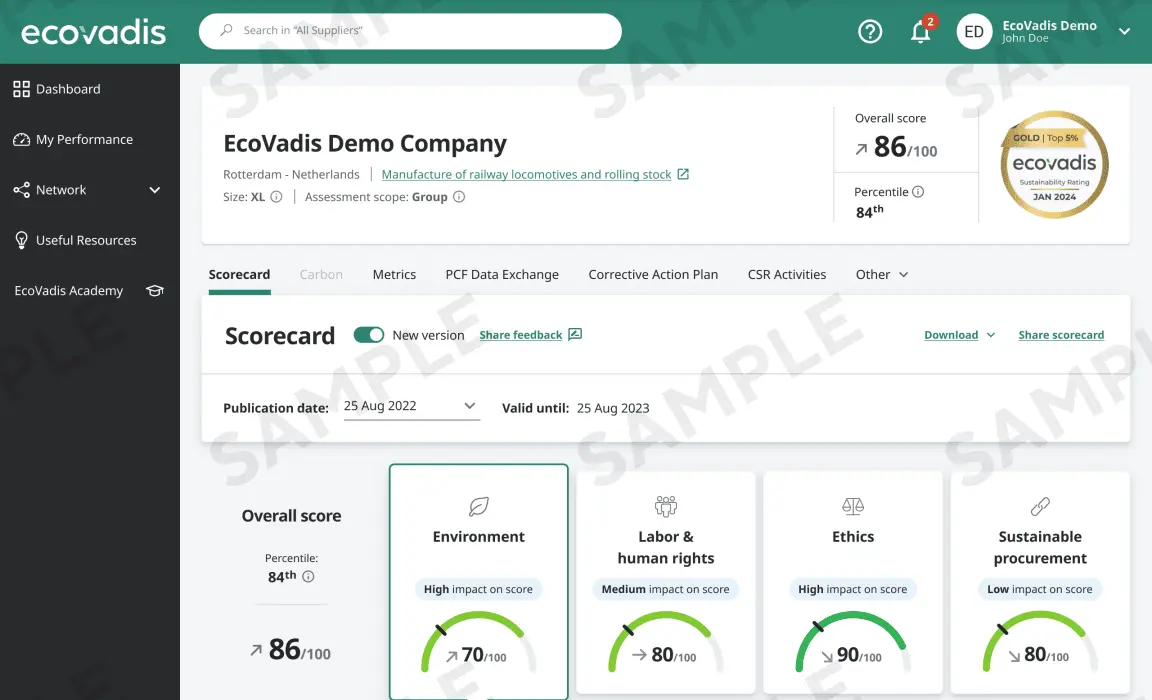
The scorecard itself is not a single grade. It shows the score for each theme and indicator, a list of Strengths and Improvement Areas, and it feeds directly into a Corrective Action Plan: every improvement area on the published scorecard automatically generates a corrective action with the status "Not started." That plan does not itself affect the score. EcoVadis does not review it, and only a reassessment changes what a scorecard says. Customers can see the plan, though, which is why leaving it untouched reads as an intention a company never acted on.
What we hear from our customers: The most common frustration is not the score itself but the explanation. Companies report documents rejected without a usable reason, a coverage score that halved without any change on their side, and no way to tell how many points a given improvement is worth. This is where the insights of experts are extremely helpful, both for a better understanding of the Scorecard and for identifying opportunities to challenge or improve your results.
When Does EcoVadis Reassess You, and What Does the Annual Cycle Look Like?
A scorecard is valid for 12 months. Reassessment is not automatic: any new sharing request made more than 12 months after the last assessment triggers one, and a customer can request a reassessment up to 3 months before a scorecard expires. EcoVadis recommends annual reassessment as standard practice.
Getting to that first scorecard runs through four official stages: registration, which EcoVadis typically completes within 6 business days; the questionnaire itself, with a default deadline of 30 business days and a self-service extension budget of up to 60 further days; expert analysis, taking 6 to 8 weeks; and results, shared automatically with the partner who invited you and valid for 12 months from publication. Registration happens once, not every cycle: after your first assessment, a reassessment starts from your existing company profile rather than a fresh registration.
The real work, though, sits in the fifth phase that EcoVadis doesn't name as its own stage: corrective actions and reassessment, which is where the remaining eleven months of the cycle actually go. This phase is easy to underestimate precisely because nothing is due during it. Evidence gathered as it is produced, rather than reconstructed the week before the next questionnaire opens, is the single largest difference between a company whose score climbs steadily and one that resubmits roughly the same gaps every cycle.
Two details catch companies off guard about timing specifically. First, questionnaires submitted after 30 September typically do not publish before the end of the same calendar year, so a customer who needs a scorecard for their annual review should be worked backward from September, not from December. Second, reassessments are subject to any methodology change EcoVadis has implemented before the reassessment begins, so starting a week later than planned can mean answering to different rules than you prepared for.
How Does EcoVadis Connect to CSRD, CDP, and the Questionnaires You're Already Answering?
An EcoVadis assessment rarely stands alone. The same underlying evidence, a sustainability report, ISO certifications, KPI data with a stated unit and reporting period, tends to answer more than one framework at once. A company already reporting under CSRD and the ESRS, or preparing a disclosure under the Voluntary Standard (VS/VSME), has usually already produced most of what an EcoVadis Environment or Labor and Human Rights criterion asks for. The reverse is also true: evidence assembled for an EcoVadis cycle often maps directly onto a CDP questionnaire, an MSCI ESG or Sustainalytics review, or a customer's own supplier self-assessment questionnaire (SAQ).
Procurement teams tend to see this most directly. A customer running SMETA or an equivalent supply-chain audit is often asking a version of the same Ethics and Sustainable Procurement questions EcoVadis already scores, and a valid third-party audit from the past two years can even take a company out of the pool EcoVadis considers for a site verification. Product-level regulation, PPWR packaging requirements or conflict minerals due diligence among them, sits a step further out, but draws on the same discipline: a claim that needs to survive a customer's or regulator's scrutiny needs a document behind it, not a description of intent.
The practical failure mode is not a lack of evidence. It is evidence that exists but sits scattered across whichever team or system produced it first, so each new request gets answered from scratch instead of from what the company already proved somewhere else. A rating, a disclosure, and a customer questionnaire are three different audiences asking overlapping questions, and the company that treats its evidence as one reusable library rather than four separate exercises spends noticeably less time on each new request.
Read more: The EU's New ESG Rating Regulation: What It Means for EcoVadis Assessments
How To Get Support With Your EcoVadis Submission
Yes, you can get help with an EcoVadis submission, whether that means software that speeds up your own team's work or handing the assessment to specialists entirely. Everything above this section is public information: EcoVadis's own rules, its published methodology, and the Sustainability Ratings Index. Two things sit behind Sunhat's own support for the process, and a company can use either one or both, whether the goal is a single assessment done well or a proof library that also answers CSRD, CDP, and the customer questionnaires described above.
Reduced to its simplest form, an EcoVadis project runs through five phases:
- Review the requirements and the documentation you need. Start from EcoVadis's own criteria and your Industry Risk Profile, not a generic template, so the search for evidence starts in the right place.
- Manage and govern tasks for collecting evidence data. Assign clear ownership so gathering documents does not fall to whoever has time that week.
- Set up continuous approval and review processes. Build a habit of checking evidence as it is produced, rather than everything at once right before a deadline.
- Gather all your sustainability data in one place. A single evidence library beats data scattered across whichever team or system produced it first.
- Contextualize sustainability data from your evidence documents. Raw data does not answer a question by itself; a stated unit, a reporting period, and a plain explanation make the difference an analyst credits.
That is the shape of it, not the detail. The document-by-document rules, the timing, and the checklists live in the Project Guide, and our team can run some or all of it for you. Want the full breakdown, or hands-on support running it? Talk to us about a project plan.
Proof Software, if your team runs the assessment. Our EcoVadis Agent pre-fills the questionnaire from previous submissions and existing documents, selecting options and attaching matching evidence. Proof AI Validation checks each document against EcoVadis's technical requirements before it is attached, catching a scan or an undated policy before an analyst does. Customers using this approach see an average score increase of 12 points in the first year, with up to 80% less manual effort on the questionnaire. See how the platform works end to end.
Proof Services, if you would rather not run it at all. Our EcoVadis Accredited Partner team, including former EcoVadis employees, has completed more than 1,000 questionnaires. We run the full assessment on the same platform, benchmark your evidence against successful assessments at the level of the individual question, and flag which documents are likely to be rejected before submission. You keep the decisions and the sign-off; we do the work. See here what a delivered assessment includes.
Are You Ready to Improve Your EcoVadis Score?
Bring us your last scorecard, and we will show you where the points are, whether you want to close the gaps yourself or hand the next cycle to our team. Talk to us.
Frequently Asked Questions
There is no fixed "good" score, since medals are awarded on percentile rank and the cutoffs move each year. The 2025 network average sits at 57.1, up from 42.4 a decade earlier, and companies newer to the network should expect to score below that average on a first assessment. A below-average first score is the norm, not a failure.
No. EcoVadis medals and badges are not certifications and cannot support product-level sustainability claims or appear on packaging. Since 1 January 2026, any external use of a medal or badge must also link to the company's EcoVadis Recognition Page.
The default deadline is 30 business days, extendable by up to 60 further business days on a self-service basis, for a maximum of 90 business days. If a company neither submits nor extends within that window, the questionnaire closes, though support can reopen one within 6 months of its creation.
Yes. Some companies run the assessment with their own team using a platform that pre-fills and validates evidence; others prefer an EcoVadis Accredited Partner's experts to complete the assessment on their behalf, with the company reviewing and signing off before submission. Both are legitimate paths, and the right one depends on internal capacity, not on the difficulty of the questionnaire itself.
No. EcoVadis reviews documented evidence against its own criteria and issues a scorecard and, where earned, a medal. It does not audit a site in person as standard practice, though a small number of assessments are selected for a separate site verification at no extra cost, and it does not certify a product or a management system in the way an ISO audit does.
A company can contest its assigned industry with supporting documents, including ISO certificates, business registration records, or local classification codes. EcoVadis reviews the request but is explicit that it cannot guarantee the requested industry will be applied, since the assignment follows the activity carrying the highest sustainability impact rather than the one a company might prefer.

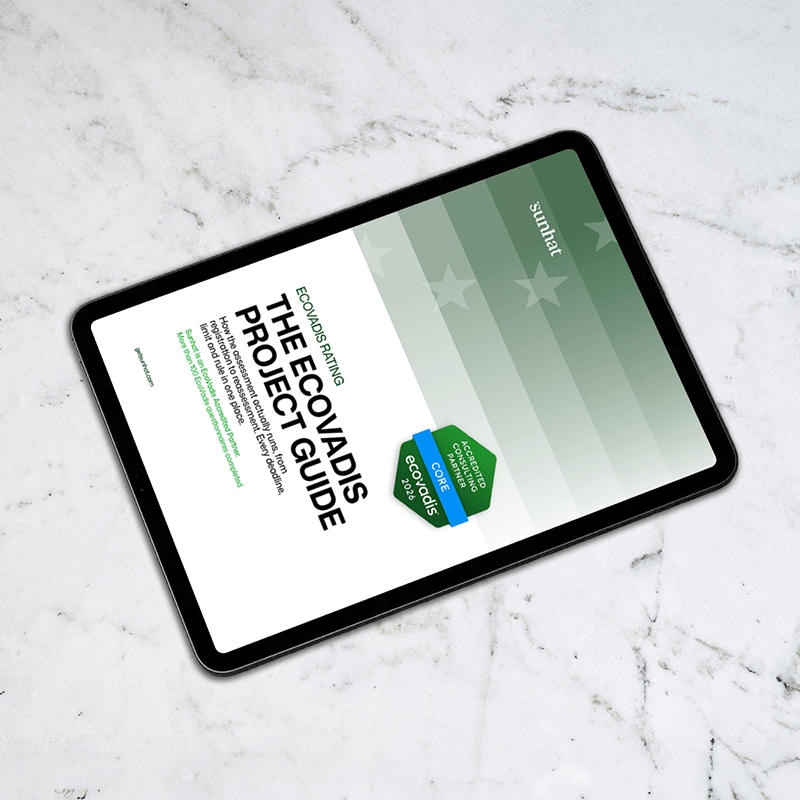
Your Full EcoVadis Project Guide
Free ressource: from registration to reassessment. Every EcoVadis deadline, limit and rule in one place.




.avif)











%201.svg)