
Latest Update July 2, 2026:
[cg_add-class=heading-style-h4]In a Nutshell
- PPWR assigns obligations by role, not by who runs the machines.
- Most packaging producers are the supplier, while the brand owner is the manufacturer and producer.
- Your role can change per component, so map each packaging item, not your whole company.
- The manufacturer signs the Declaration of Conformity; as a supplier you supply the evidence behind it.
- Customer questionnaires are the real deadline, arriving ahead of 12 August 2026.
Most packaging producers we talk to assume PPWR makes them the "manufacturer." They make packaging, so the manufacturer obligations must be theirs. For a lot of corrugated and cardboard converters, that assumption is wrong. It quietly shapes every decision that follows: who signs the Declaration of Conformity, who holds the technical file, who carries the Extended Producer Responsibility fees. The good news is that the fix is simple, and you can do it well before the deadline.
The Packaging and Packaging Waste Regulation (EU) 2025/40 starts applying on 12.08.2026. It does not assign obligations by who runs the machines. It assigns them by role. And a single producer usually holds more than one role at once, sometimes a different one for every component on the line. Get the role right and the rest of PPWR becomes a manageable checklist. Get it wrong and you either claim duties that are not yours or miss the ones that are.
This piece is for compliance and sustainability teams at packaging producers, written around the question that decides everything else. Here, we stay on your side of the supply chain.
PPWR in Brief, for Producers Only
As of June 2026, PPWR replaces the old Packaging and Packaging Waste Directive with one regulation that applies directly in every member state. There is no national transposition to wait for. The headline date for producers is 12.08.2026. From then, most operator obligations begin to bite, including the requirement that packaging placed on the market carries a Declaration of Conformity backed by technical documentation.
{{cta-cs}}
You do not need the entire regulation to act. You need to know which obligations attach to your role, then work outward from there. The substance restrictions, recyclability rules, recycled-content targets, and labeling requirements all matter, but they land differently depending on whether you are the manufacturer, the supplier, or the producer of a given packaging item. That is why role comes first. Everything downstream depends on it.
The Five PPWR Roles, and Why You Hold More Than One
PPWR defines a chain of economic operators in Article 3, and the words do not match shop-floor language. Five roles matter for packaging producers:
The manufacturer makes packaging and places it on the market under its own name or trademark, and signs the Declaration of Conformity for it. The supplier provides packaging or packaging material to a manufacturer. The producer is the operator that first makes packaging available on a national market, which is the role that triggers Extended Producer Responsibility registration and fees. The importer brings packaging from outside the EU into the market. The distributor makes packaging available without being any of the above.
Here is the trap. In everyday speech, a company that runs a corrugator and a die-cutter is "the manufacturer." In PPWR, "manufacturer" is tied to whose name or trademark the packaging carries and who signs for its conformity. So the brand owner you supply is frequently both the manufacturer and the producer of the finished packaging, while you, the company that physically made the box, are the supplier. One company, in one transaction, can sit in a different role than its own machines suggest.
The Converter Case: You're Usually the Supplier, Not the Manufacturer
For a typical corrugated or cardboard converter selling to brand owners, the most common role is supplier. You provide packaging and packaging material to a manufacturer who markets the packaged product under their name. That manufacturer signs the Declaration of Conformity for the packaging as placed on the market. That same brand owner, as the operator first making the product available nationally, usually carries the producer role and its EPR obligations.
This is not a downgrade of your responsibility. The supplier role still requires you to hand your customers the data they need to sign their declaration: material composition, recycled-content figures, recyclability assessment, substance compliance, weight and minimization evidence. Without your documentation, your customer cannot complete theirs. The obligation to sign sits with them. The obligation to prove sits substantially with you. That split is exactly why your customers are about to flood you with questionnaires, which we come back to below.
Your Role Changes per Component
Stop asking what your company is under PPWR. Start asking what your role is for each item. The answer changes per component, and a producer can hold several roles across one product line at once.
Take a converter that does three things. It supplies plain corrugated shippers to a food brand, so for those it is the supplier and the brand is the manufacturer. It also sells its own branded retail-ready display under its own trademark, so for that line it is the manufacturer and signs the Declaration of Conformity itself. And it imports a specialty coated board component from outside the EU to finish a third product, which pulls in importer obligations for that material.
Same company, same week, three different PPWR roles. A role map built component by component is the only reliable way to see which obligations actually land where. This is the worksheet at the center of our toolkit.
Once You Know Your Role, What You Actually Owe
With roles mapped, the obligations become concrete and manageable. Which ones are yours depends on the role you hold for each item, and the PPWR compliance hub covers each one in depth.
In short: the operator acting as manufacturer signs the Declaration of Conformity, drawn up on the Annex VIII model under Article 39, and holds the technical documentation. Retention runs five years for single-use packaging and ten years for reusable packaging. As a supplier you do not sign it, but you supply the evidence behind it and keep your own records.
PFAS in food-contact packaging carry specific restrictions under Article 5(5), and minimization under Article 10 asks you to show the packaging is no heavier or larger than its function needs. Recycled-content rules fall mainly on plastic components, so a fiber-led converter usually passes these through on laminations, windows, and tapes. EPR registration and fees sit with the producer that first places packaging on a national market, which for most converters is the brand owner, not you.
Why Your Inbox Is Filling with Customer Questionnaires
The pattern we see most often across packaging producers is not the expected letter from an authority. It is a wave of customer questionnaires already hitting before the August deadline. Brand owners realize they must sign Declarations of Conformity by 12.08.2026. They realize the evidence sits with their suppliers. So the requests land on you: material breakdowns, recycled-content percentages, recyclability grades, PFAS statements, and weight data, often in a different template for every customer.
This is the real deadline for many producers. The regulation applies in August 2026, but your customers set their own timelines earlier, because they cannot complete their obligations until you complete yours. The producers who fall behind answer each questionnaire from scratch, re-deriving the same figures in a slightly different format every time. The producers who lead the way organize the underlying evidence once in a single source of truth, map it to role, and reuse it across every request.
This is exactly the proof gap we built Sunhat to close: the distance between having the data and being able to substantiate it on demand. Our Collaborative Proof Platform turns your data into proof, holding your role map and evidence as one reusable source. Proof AI knows where each answer lives and drafts it for you, so the next questionnaire takes minutes instead of a morning. You already do the work. We help you prove it.
Where to Start before 12.08.2026
The work itself is straightforward. Map your role for each component, not for the company as a whole. Separate where you sign from where you only supply. Then assemble your substance and material evidence first and organize it once, so it is reusable across every customer request.
That is exactly what the PPWR Producer Toolkit walks you through, step by step. None of this requires waiting for further guidance: the roles are defined, the obligations are set, and the customer questionnaires are already arriving.
Find your role first
PPWR does not reward the company that worries hardest. It rewards the company that knows where it stands for each item and can prove the matching facts on demand. For most packaging producers, that starts with a quietly surprising conclusion: you are probably the supplier, not the manufacturer, and your job is to make your customers' proof effortless. Good role mapping makes that not just possible but straightforward.
Our PPWR Producer Toolkit walks you through it: a role worksheet to map every component, a response playbook for the questionnaire flood, a Declaration of Conformity checklist, and a readiness scorecard. It is built for packaging producers, not for the whole supply chain. It turns confusion into a finished map you can act on, and it shows you which obligations are possibly yours.
Download the PPWR Producer Toolkit and find your role before August.
This article explains regulatory obligations in general terms and is not legal advice. Confirm your specific obligations against Regulation (EU) 2025/40 and current Commission guidance.
It's Time to Prove
What You Already Do
Your next questionnaire, assessment, or audit meets traceable proof.
With Sunhat, you verify your evidence once, then reuse it everywhere.
See how you can get there.

.avif)

Frequently Asked Questions
Not always. Under PPWR, "manufacturer" means the operator that places packaging on the market under its own name or trademark and signs the Declaration of Conformity. A company that physically makes packaging for a brand owner is often the supplier, not the manufacturer, even though it runs the machines.
Usually the supplier. If you provide packaging or packaging material to a customer who markets the packaged product under their name, that customer is the manufacturer and you are the supplier. Your role can still change per component, so map each item rather than labeling your whole company.
The operator acting as manufacturer signs it, drawn up on the Annex VIII model under Article 39 and backed by technical documentation. If you are a supplier, you do not sign the declaration. You provide the underlying evidence your customer needs and keep your own records.
Yes. PPWR covers all packaging placed on the EU market, including paper-based and corrugated packaging. Fiber-based producers carry fewer recycled-content obligations than plastics, but they still handle minimization, recyclability, substance, and documentation requirements tied to their role.
Regulation (EU) 2025/40 entered into force on 11 February 2025 and applies from 12 August 2026. Most operator obligations, including the Declaration of Conformity requirement, take effect on that date, while several design and target rules phase in later.
The producer: the operator that first makes packaging available on a national market. That party registers and pays EPR fees in each member state where it does so. For converters supplying EU brand owners, the brand owner usually carries this. If you place your own packaging on a market, it is yours.

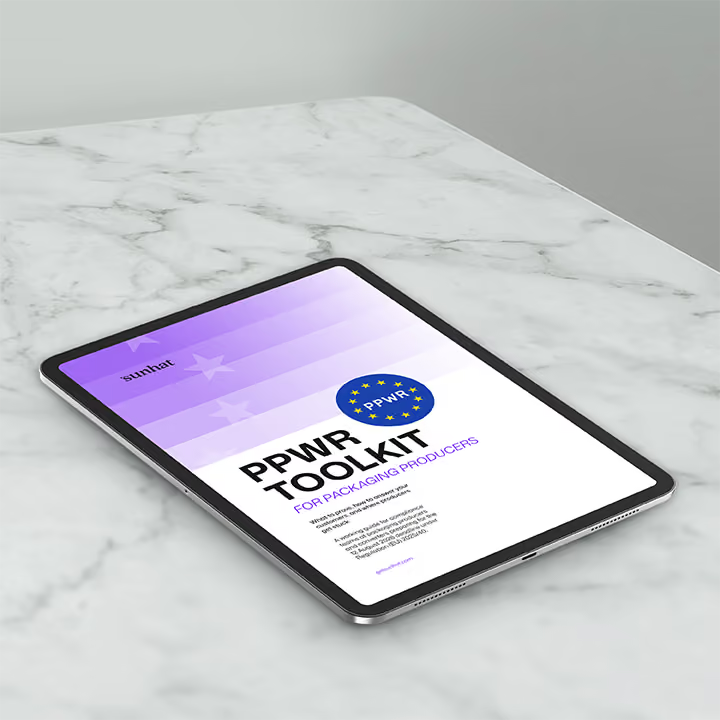
Everything Packaging Producers Need for PPWR Compliance Now
Free Toolkit: What to collect, how to prioritize, and where most packaging producers get stuck.



%201.svg)