
Latest Update November 18, 2026:
[cg_add-class=heading-style-h4]In a Nutshell
- Capacity, not knowledge, usually decides whether to outsource ESG reporting. If ESG work is a side job for one or two people, a service is often the faster route.
- Outsourcing is not all-or-nothing. You can start with a gap analysis, get guided support while your team answers, or hand over the drafting completely.
- Data, decisions and sign-off have to stay with you, whoever does the work.
- An answer without a source and an expert review is not proof. Ask every provider how they guarantee it.
The EcoVadis reassessment is due, a key customer wants verified emissions data within two weeks, the bank asks for a VSME report, and three more supplier questionnaires arrived this morning. In many mid-sized companies, all of it lands with the same one or two people, who also have a day job. As of November 2026, this is the situation we hear about most often when companies ask us whether they should outsource ESG reporting.
Yes, you can outsource ESG reporting. A service provider can take over the data mapping, drafting and expert review for reports, ratings such as EcoVadis and CDP, and customer questionnaires. What you cannot outsource is your data, your decisions and your sign-off. Outsourcing pays off when each answer comes back with its source, reviewed by an expert, ready for your approval.
Five Ways to Get ESG Reporting Done
Most companies do not choose one model for everything. They mix them per framework: a team may run its CDP response largely on its own in software, while experts take over the EcoVadis assessment. These are the five options and what each one means for your team.
The line between the last two options matters more than it looks. A classic consultant often works in their own templates, and what comes back is a document. A full service built on proof software works from your evidence, and every answer carries its source and its review. More on that below.
When Outsourcing ESG Reporting Makes Sense
Outsourcing makes sense when the bottleneck is time, not know-how. These are the signals we see most often:
- ESG is a side job. The quality manager, the EHS lead or the managing director answers the questionnaires on top of everything else.
- One person owns every framework. For example, a sustainability manager we spoke with spends at least a month on EcoVadis alone, in one- to three-hour slots between strategy work, carbon footprints and new legislation.
- A hard deadline is close. A customer wants verified data within weeks, a rating reassessment is due, or a bank needs a report before a credit decision.
- The framework is new to you. The first EcoVadis assessment, the first CDP response or the first VSME report take the most effort, and mistakes made there are repeated every year.
- Requests are piling up. A two-person team answering around 40 customer requests a year has little time left for anything else.
- There is no software budget, or IT limits new tools. We see this often: a service can come out of a different budget and needs no software rollout or IT approval.
If two or more of these apply, a full service or guided support is usually the better choice than adding another tool your team has no time to use.
{{cta}}
When Keeping It In-House Is the Better Call
Outsourcing is not the right answer for everyone. Keeping ESG reporting in-house is the better call when:
- Requests are frequent and predictable. If your team answers questionnaires every week, building the routine in-house with good software pays off faster than briefing a provider each time.
- You want the know-how in your company. Some sustainability teams reject outside help as a matter of principle, and for good reason: the knowledge of how the company works stays with the people who run it.
- You need full control over every answer and every timeline. Some companies prefer to own the whole process, especially when ESG data is closely tied to strategy or investor communication.
In these cases, the question is not whether to outsource, but which software fits your team. Our ESG software checklist covers what to look for.
What You Can't Outsource
Whoever does the work, three things stay with you.
- Your data owners. Energy figures come from facilities, headcount from HR, supplier data from procurement. A provider can tell you exactly which figure is needed and from whom. A data request plan that lists who provides which figure by when is the simplest way to organize this. But the people who own the data still have to deliver it.
- Your decisions. Targets, policies and commitments are management decisions. A provider can draft a policy, but your company has to stand behind it.
- Your sign-off. Nothing should go to a customer, rating provider or bank without your approval. A good service makes this an explicit step, not an afterthought.
We have seen what happens when this is underestimated. In one company we spoke to, half of the internal stakeholders were unhappy with the consultant who ran their last EcoVadis round. The result only held up because the internal teams put in the extra work themselves.
Answers Are Not Proof
The most important question about outsourcing is not who writes the answers. It is whether each answer can be proven.
AI alone does not close the gap. General AI tools write fluent answers fast. One company told us it tried EcoVadis on its own, created the required documents with ChatGPT and fell short of the needed medal. The managing director concluded that they needed professional support.
A quality director put it this way: anyone can write a sustainability policy with ChatGPT in 20 minutes, but that is not the standard his company wants to meet. Sustainability teams also tell us that general AI tools answer each question acceptably but silently leave out topics, so someone has to keep prompting. And they do not follow the methodology changes that rating providers such as EcoVadis make between cycles.
Outsourcing alone does not close it either. Brand names are no guarantee. One of the Big Four had to pay back the final installment of a government contract in 2025 after its report turned out to contain fabricated references and a made-up court quote, produced with the help of a generative AI tool. Closer to everyday ESG work, one company told us their consultant only typed their answers into the EcoVadis platform. The score stalled just short of a medal, and the team concluded they could have done it themselves.
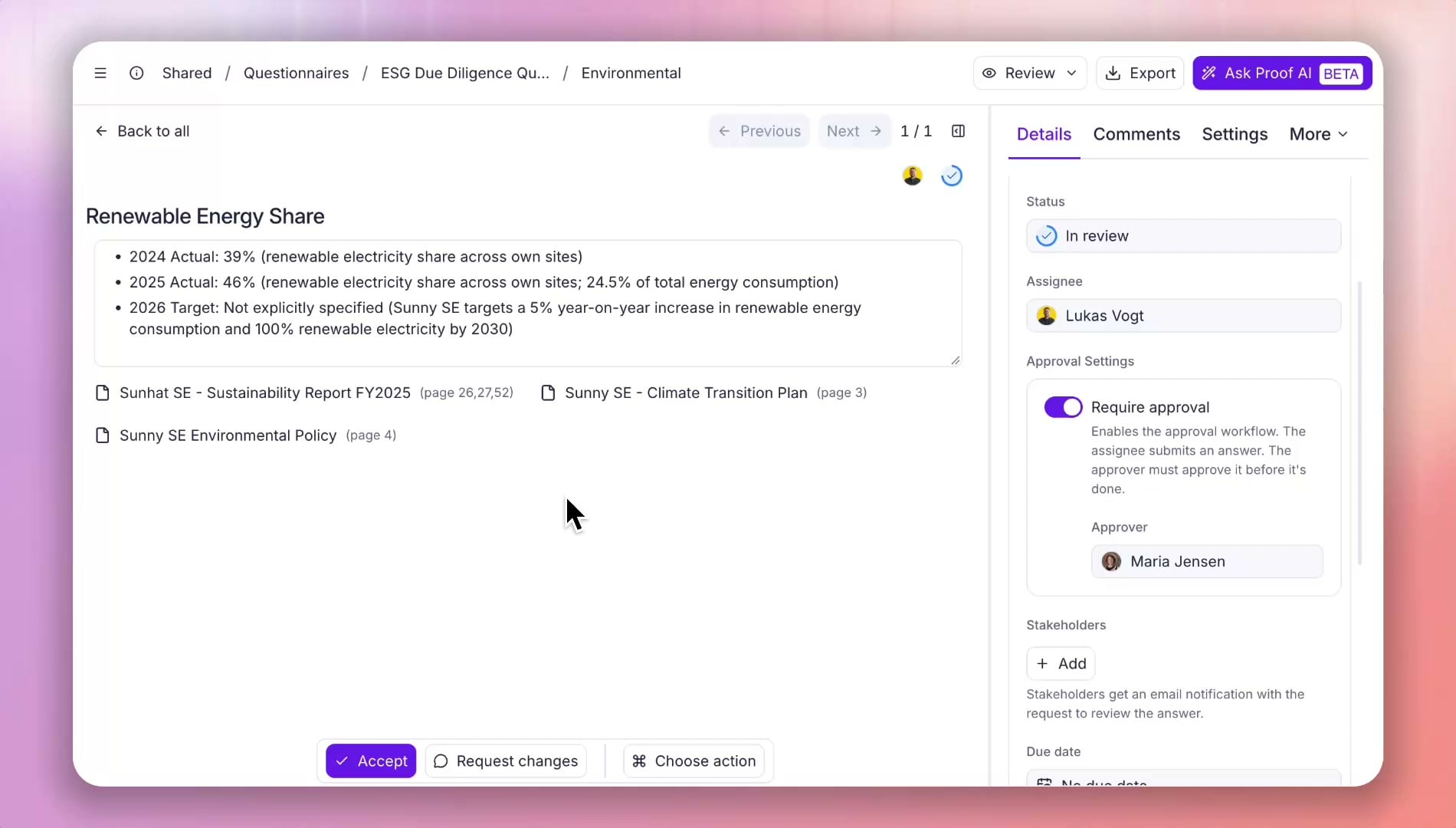
Proof has three parts: a source behind every answer, a review by someone who knows the current requirements, and sign-off by the company. A provider who works this way flags gaps instead of guessing. That is the standard to hold any ESG reporting service to. The good news: most of the evidence already exists in your company. It just needs to be found, linked to the answer and checked.
What Drives the Cost of Outsourced ESG Reporting
The cost of outsourcing ESG reporting depends less on the provider's day rate than on four drivers:
- Volume: how many frameworks, reports and questionnaires you need answered per year.
- Data readiness: whether your data and documents exist and are easy to find, or have to be built first.
- Scope and depth: a one-off gap analysis costs less than guided support through a whole cycle, and guided support costs less than a full service.
- Urgency: a deadline in two weeks needs more people at the same time than a deadline in six months.
Compare the total cost, not only the invoice. That includes the internal time your team still spends, and the cost of switching providers later. For example, one company that changed carbon consultants found that each one had categorized their emissions differently, so years of historical data had to be reconciled by hand.
Questions to Ask Any ESG Reporting Provider
Before you sign, ask every provider these questions:
- Is every answer backed by a source? Ask to see an example.
- Who reviews the answers, and with what qualification? For EcoVadis, for example, ask whether the provider is an accredited partner.
- Do you flag gaps instead of guessing? A provider who fills every field without asking is a risk, not a shortcut.
- What do you need from us, and when? You should get a clear list of data, documents and contacts.
- Can we start with a gap analysis only? It shows you where you stand before you commit to more.
- Do we get the answers back in the original file or portal? Customer questionnaires often have to be returned in their own format.
- What do we get back at the end? The report, the source documents and the submitted answers should all be yours.
- Can we take over ourselves later? Your needs may change once the first cycle is done.
Outsource the Work, Get Proof: Proof Services by Sunhat
At Sunhat, we built Proof Services around the standard above. Our experts work on the Sunhat Proof Software, where Proof AI drafts each answer from your evidence and an expert reviews it against the current requirements. With guided support or the full service, you can get access to your project in Proof Software, so you can follow progress and review each answer next to its source. We recommend it, but it is not required: if your IT policy rules it out, we deliver the same service without software access.
This is how the work is divided:
Proof Services cover sustainability reports to GRI, VSME or whichever standard your bank or customer asks for, EcoVadis assessments, CDP responses, customer questionnaires and double materiality assessments. You choose the depth per framework: a gap analysis only, guided support while your team answers, or the full service. For questionnaires, you forward the request by email, and it comes back reviewed in the original file. For portals, we fill in and you submit. As an accredited EcoVadis partner, we know where assessments lose points.
And if your volume grows or your team gains capacity, you can take over in Proof Software yourself.
It's Time to Prove
What You Already Do
Your next questionnaire, assessment, or audit meets traceable proof.
With Sunhat, you verify your evidence once, then reuse it everywhere.
See how you can get there.



Frequently Asked Questions
You can outsource most of the work: data mapping, drafting, expert review and the final report or submission. What stays with your company is providing the data, making decisions such as targets and policies, and signing off. A good provider makes your approval an explicit step before anything goes out.
It depends on your capacity. Software suits teams with time to answer requests regularly. A consultant or service suits teams without that time or facing a hard deadline. Many companies combine both, for example by running CDP in-house with software and handing the EcoVadis assessment to experts.
Yes. A service provider can run the gap analysis, collect and create the evidence, draft the answers and prepare the submission. The company stays responsible for its data and approves the submission. Accredited EcoVadis partners, such as Sunhat, know the methodology and its changes in detail.
General AI tools can draft text quickly, but they do not know your evidence, they leave out topics without telling you, and they do not follow rating methodology changes. Every answer still needs a source and an expert review. AI is useful inside a process with evidence and review, not as a replacement for it.
Yes, and it is a common path: start with a service for the first cycle or an urgent deadline, then take over once your team has the capacity. With Sunhat, you can switch from Proof Services to Proof Software.


What Manual Proof Work Costs Your Team
Discover your estimated time and money spent on ESG and compliance work with our free Proof Gap Cost Calculator.