
Latest Update April 21, 2026:
[cg_add-class=heading-style-h4]In a Nutshell
- ISO 14001:2026 was published on 15 April 2026, replacing ISO 14001:2015. All certified organizations must transition by May 2029.
- The revision explicitly requires consideration of climate change, biodiversity, natural resource availability, and pollution levels when analyzing organizational context.
- A new Clause 6.3 introduces formal change management requirements for the EMS. Lifecycle thinking is now embedded across scope, aspects, and operational controls.
- The scope of changes is moderate. Organizations already certified to ISO 14001:2015 can treat this as a structured update, not a rebuild.
ISO 14001:2015 served as the global reference for environmental management for over a decade. On 15 April 2026, ISO published its successor. The changes are not dramatic, but they are deliberate: climate, biodiversity, lifecycle thinking, and supply chain controls are no longer implied. They are explicit requirements. The three-year transition clock is running.
This guide breaks down the key changes clause by clause, maps the transition timeline, and provides a practical checklist to get your environmental management system (EMS) ready for ISO 14001:2026. If you need a refresher on the fundamentals of ISO 14001 implementation, see our ISO 14001 implementation guide.
What Is ISO 14001:2026?
ISO 14001 is the most widely adopted EMS standard in the world. Hundreds of thousands of organizations use it to structure their environmental responsibilities, manage compliance obligations, and drive continual improvement in environmental performance.
The 2026 edition replaces ISO 14001:2015 and incorporates the climate change amendment issued in 2024. It retains the same core PDCA (Plan-Do-Check-Act) structure and aligns with the latest version of ISO's Harmonized Structure for management system standards.
The central objective of the revision: clarify existing requirements and address emerging environmental priorities while keeping the introduction of entirely new requirements to a minimum. DNV, one of the certification bodies involved in the revision process, describes the scope of changes as "moderate" and "not expected to demand significant implementation efforts" from organizations already certified to ISO 14001:2015.
Key Changes in ISO 14001:2026
The revision touches most clauses, but concentrates its impact in five areas. Here is what matters.
Broader Environmental Context (Clauses 4 and 5)
Environmental conditions must now be explicitly considered when analyzing the organizational context. ISO 14001:2026 names four categories that organizations cannot overlook: climate change, pollution levels, biodiversity and ecosystem health, and availability of natural resources. This is not entirely new territory for mature EMS setups, but the standard now requires documented evidence that these factors have been assessed.
The EMS scope must also reflect a lifecycle perspective, extending the organization's view beyond its own facilities and direct operations.
On the leadership side (Clause 5), top management responsibility now extends beyond management roles to all relevant functions. The environmental policy must support conserving natural resources and protecting ecosystems.
Structured Change Management and Planning (Clause 6)
The most visible structural addition is Clause 6.3: a formal requirement to plan and manage changes that affect the intended outcomes of the EMS. This applies to changes driven by internal factors (new processes, organizational restructuring) and external factors (regulatory shifts, supply chain disruptions).
The planning section is also restructured. Emergency situations are now separated from abnormal operations, and risk and opportunity planning is split into two distinct steps: identifying risks and opportunities (Clause 6.1.4) and planning actions to address them (Clause 6.1.5).
Lifecycle Thinking and Supply Chain Controls (Clauses 4 and 8)
Lifecycle thinking has been part of ISO 14001 since the 2015 edition, but the 2026 revision strengthens it significantly. The lifecycle perspective now applies to scope definition, environmental aspect identification, and operational controls. Organizations are expected to look upstream and downstream, not just at their own operations.
The terminology around outsourcing changes too. "Outsourced processes" becomes "externally provided processes, products, or services," and operational controls must extend to suppliers and partners where their activities are relevant to the EMS outcomes. For organizations with complex supply chains, this means stronger visibility and documentation requirements.
Sharper Performance Evaluation (Clause 9)
Clause 9 now explicitly requires organizations to evaluate both environmental performance and EMS effectiveness (not just one or the other). Internal audits must define objectives in addition to scope and criteria. This gives audit programs a clearer purpose and traceability.
Management reviews are restructured into three sub-clauses: inputs, process, and results. The information requirements for management reviews are more clearly articulated and must be documented as evidence.
Documentation and Terminology Updates
Across the standard, documentation language is standardized: all EMS records must be "available as documented information." The term "meet compliance obligations" replaces "fulfil compliance obligations." Clause 10 is simplified: the old Clause 10.1 is removed, and its content is integrated into 10.2 (nonconformity and corrective action) and 10.3 (continual improvement).
The guidance sections throughout the standard have also been substantially extended to support interpretation.
ISO 14001:2026 Transition Timeline
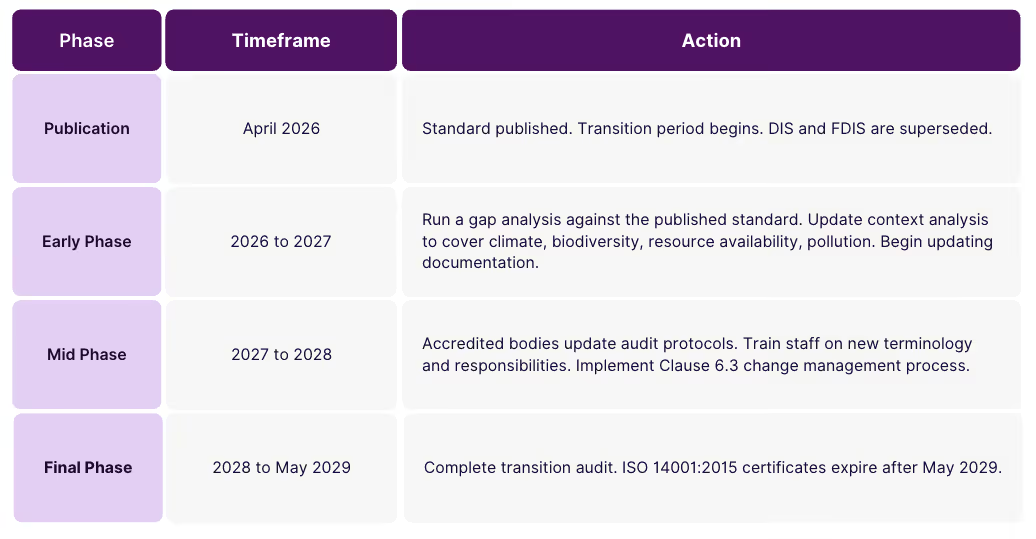
Certified organizations have three years from the date of publication. Here is how the transition breaks down:
How to Prepare: A Practical Transition Checklist
Start now, even if your next surveillance audit is two years away. These nine steps cover the essential ground:
- Run a gap analysis against the published ISO 14001:2026 requirements. Identify where your current EMS documentation, processes, and evidence fall short of the updated clauses.
- Update your context analysis to explicitly address climate change, biodiversity loss, resource availability, and pollution. These four categories must be documented as part of your organizational context (Clause 4).
- Integrate lifecycle thinking into your EMS scope definition and environmental aspect assessment. Look upstream (suppliers, raw materials) and downstream (product use, end-of-life).
- Establish a formal change management process for EMS-related changes (Clause 6.3). Define how changes are identified, planned, approved, and documented.
- Review and extend operational controls to cover externally provided processes, products, and services. Map your supply chain exposure and determine where you need visibility.
- Update internal audit procedures to include defined objectives per audit (not just scope and criteria).
- Restructure your management review process to align with the three sub-clause format: inputs, process, and results.
- Train staff on new terminology and expanded responsibilities. The revised standard extends leadership accountability beyond management roles.
- Engage top leadership early. The 2026 revision strengthens the expectation that senior leaders actively support environmental management across all relevant functions.
Why Audit Readiness Matters More Than Compliance Checklists
The transition is not just a documentation exercise. With expanded scope (lifecycle perspective, supply chain controls, biodiversity considerations), the volume of proof your organization needs to maintain grows significantly. Scattered evidence across SharePoint folders, email threads, and local files creates real risk when the auditor arrives.
This is where a structured approach to proof management makes a measurable difference. We built our Collaborative Proof Platform to solve exactly this problem:
- Pre-configured ISO 14001 blueprints translate every clause into actionable tasks. Your team sees what is required, what is complete, and what is missing.
- Live readiness score shows your percentage of completion and highlights expired or missing documents in real time.
- Cross-standard reuse: a single Environmental Policy can satisfy requirements for ISO 14001, CSRD, and EcoVadis simultaneously. No duplicate work.
- Audit trail automation with click-to-source traceability for every answer and document.
- Proof AI uses your verified internal documents to suggest answers. Zero hallucinations, 100% auditable.
The 2026 revision sharpens what ISO 14001 has always been about: systematic EMS practice that delivers measurable results. Organizations that treat this transition as an opportunity to strengthen their EMS, not just update their paperwork, will come out ahead. The transition window is generous. The earlier you start, the smoother the audit.
Ready to see where your EMS stands against ISO 14001:2026? Book a consultation to get a guided walkthrough of Sunhat's Collaborative Proof Platform.
It's Time to Prove
What You Already Do
Your next questionnaire, assessment, or audit meets traceable proof.
With Sunhat, you verify your evidence once, then reuse it everywhere.
See how you can get there.



Frequently Asked Questions
The changes are moderate. No entirely new requirements are introduced, but several clauses are revised for greater clarity and accountability. The biggest shifts involve explicit climate and biodiversity considerations, a new change management clause (6.3), and stronger lifecycle and supply chain controls.
Certificates issued to ISO 14001:2015 must transition to the 2026 edition by May 2029. The three-year window starts from April 2026. We recommend starting with a gap analysis now rather than waiting until 2028.
No. Organizations already certified to ISO 14001:2015 can treat this as a structured update. A gap analysis against the published standard is the recommended starting point. Most existing documentation and processes will carry over with targeted adjustments.
ISO 14001:2026 aligns with the latest Harmonized Structure for management system standards, which should improve integration. If you run an integrated management system, plan the ISO 14001 transition alongside your other standards to maximize synergies in documentation, audits, and risk analyses.
ISO 14001:2015 certificates will no longer be valid after May 2029. Organizations that have not completed the transition audit by then risk losing their certified status. This can affect customer relationships, tender eligibility, and ESG ratings that rely on a valid ISO 14001 certificate.

Start Your ISO 14001 Certification Today
Free Checklist with Proven Strategies from 100+ ESG Assessments




%201.svg)